Do you have any unfinished felting (or other textile) projects? Or do you want to share a recent piece that you created?
Play Time!
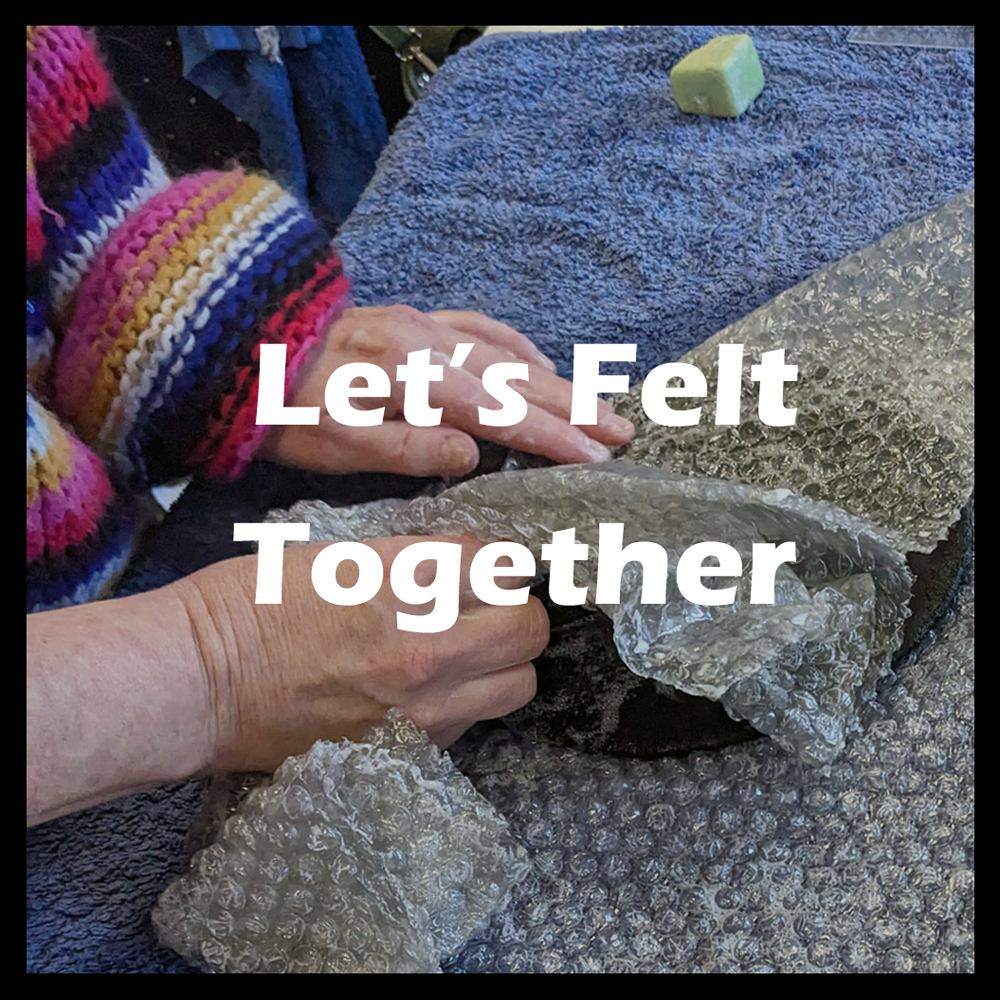
All guild members are invited to attend this coming Sunday’s session on the 13th of October. You are welcome to bring any wet or needlefelting projects you are working on and the supplies needed to create them.
Students who were part of Judit Poc’s Felted Eyeglasses Case Workshop on the 6th of October are encouraged to bring their WIP and/or completed cases to show off!
Members are also welcome to bring completed felted creations and have the option of selling them to other members! We have so many talented members! (Payment arrangements will need to be taken care of by the sellers).
We will play and share together this Sunday Session!
When: Sunday, the 13th of October, 10:30 AM – 12:30 PM.
There is ample parking outside the Hall, and the G1, G2, and number 60 buses have a stop on nearby Sarsfield Road.
Additional Information
A Sunday Session like this will require lots of tea/ coffee/cake and chat, so there’ll be an abundance of that. Of course, homebakes are always welcome! Please bring a ‘keep cup’ or mug from home if possible. That will lessen the amount of paper cups thrown away.
There is the usual 5 euro fee.
Note: Since this is the season of colds and coughs, let’s not share them. However, we welcome you to join via Zoom Link, which we email to all members.
Disclaimer for Feltmakers Ireland Blog
Feltmakers Ireland aims to share information about awards, education, events, exhibitions, and opportunities that you will find interesting. Our sharing is neither paid for by nor an endorsement of these individuals or organisations.
Contact Us: If you have any concerns about content, please email us at feltmakersie@gmail.com.
Questions: For questions about content, please follow the link to the organisation involved in hosting the event.
Crafting felted artworks presents a stimulating challenge. However, the intricacies of preparing art for display can pose an even more significant challenge. How do you figure out how to hang or present your creations? This article by guild member Lorna Cady will help explain some issues to keep in mind.
By Lorna Cady
Notes on Exhibiting for Optimal Effect
Hanging
Most pieces in Feltmakers Ireland’s annual exhibition will be hung. The Phoenix Park Visitor Centre walls are made from attractive natural-coloured stone. Near the top of the gallery’s walls, there are wire devices with hooks suspended from a curtain rail. Exhibits can be attached at suitable intervals from this.
Please ensure your piece has some form of secure hanging loop or other device that will hold the weight of the piece throughout the exhibition.
a] Size To ensure we can hang as many pieces as possible (the typical display method), please keep the width of your artwork, including the frame, within 60cm. This will allow more work to be shown rather than a few large pieces. There is no reasonable limit on height, although any pieces more than the room’s height (about 3 metres) could be logistically challenging to install! Of course, the shape of your piece need not be square or rectangular.
b] ‘Flatness’ of exhibit – or not Often, felted creations are flat, like paintings made from wool; however, they may be three-dimensional – with bumps and protrusions. Both types of work can be hung successfully.
Presenting without a frame
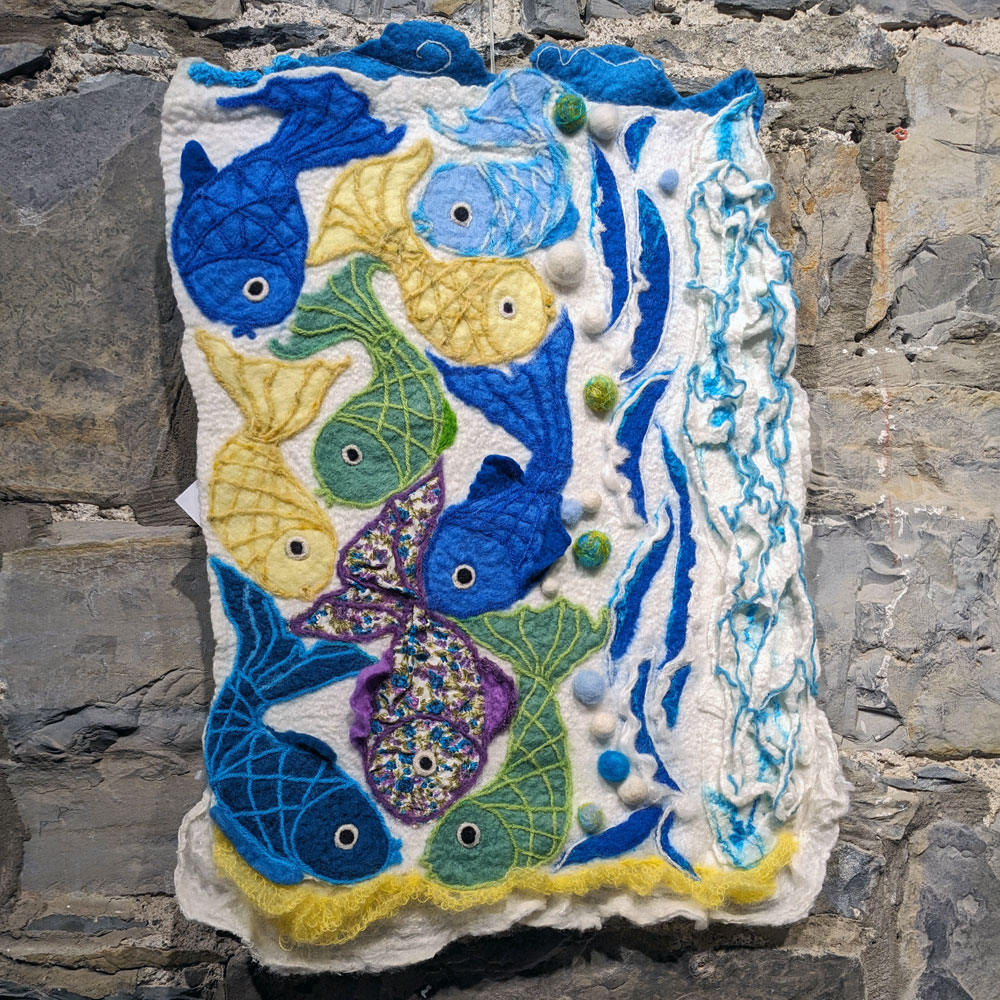
An example of a piece that is unframed. It is created by member Eithe O’Dea.
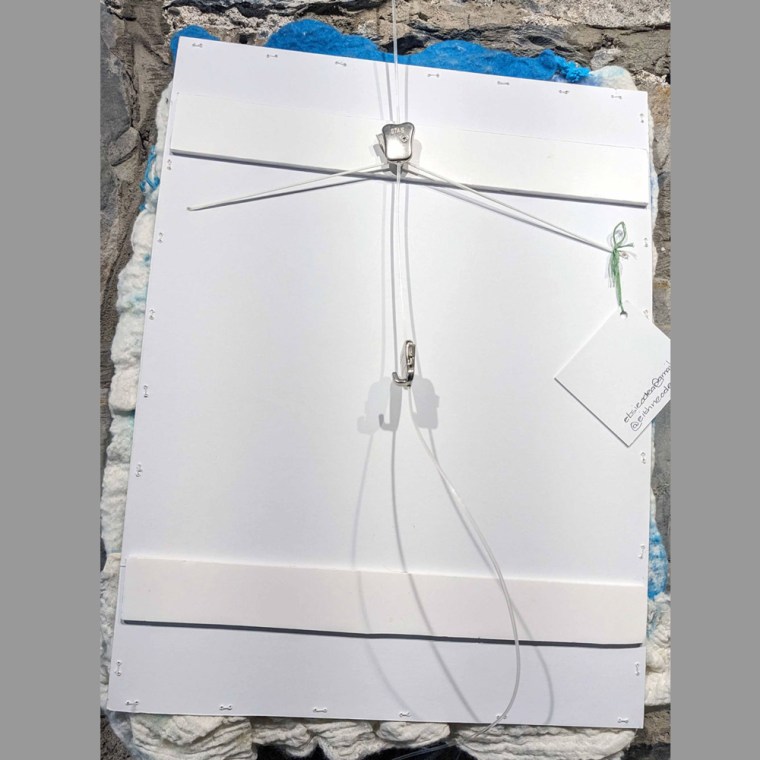
The use of board and battens on the back of this piece.
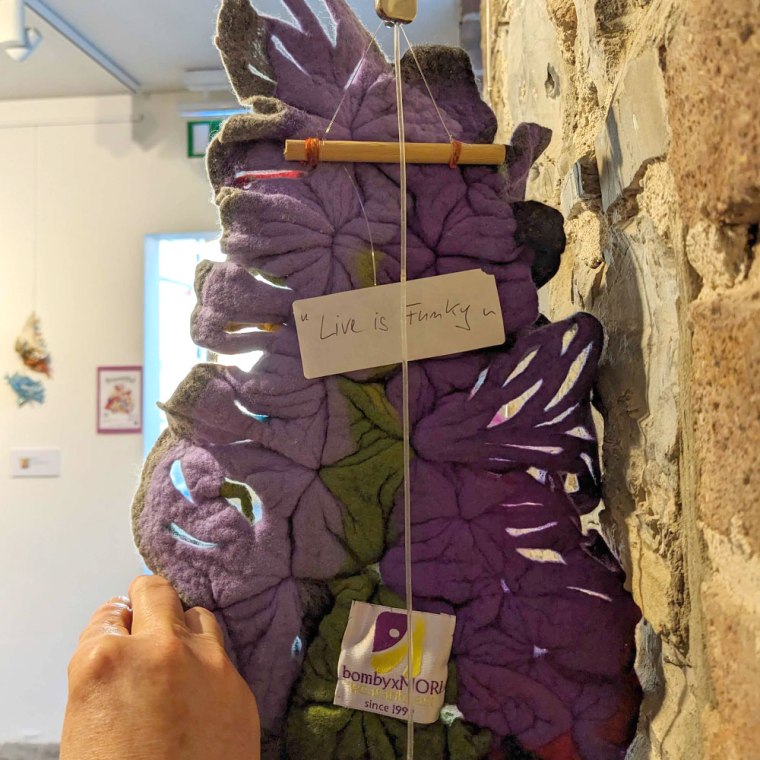
Use of bamboo and twine. Note how the artist included her label and the title of the piece. Created by guild member Astrid Tomrop-Hofmann.
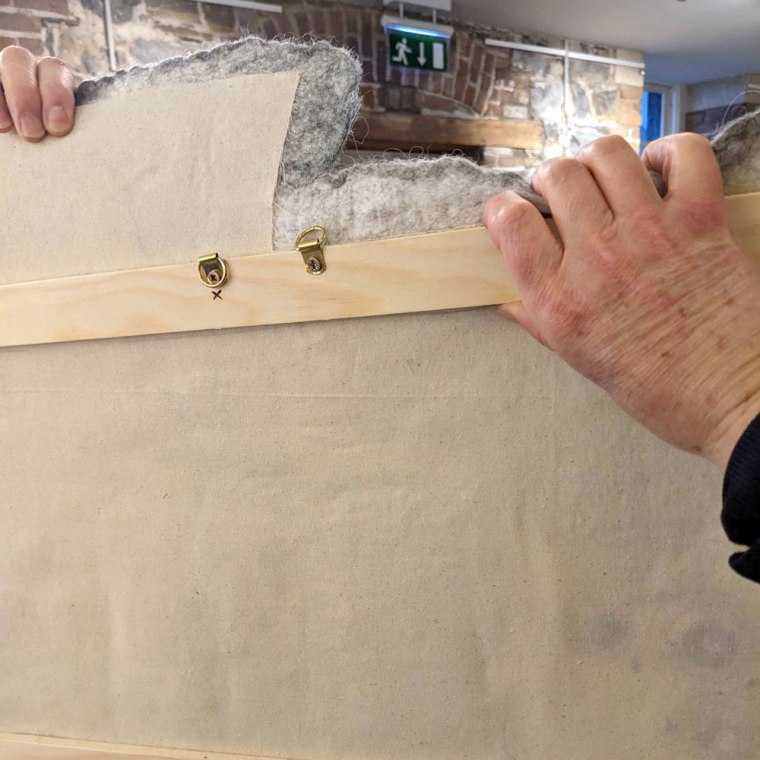
The back of this piece has chanvas sewn on and battens glued to the fabric. There are hanging hooks screwed into the wood. This wall piece is by member Fiona Leech.
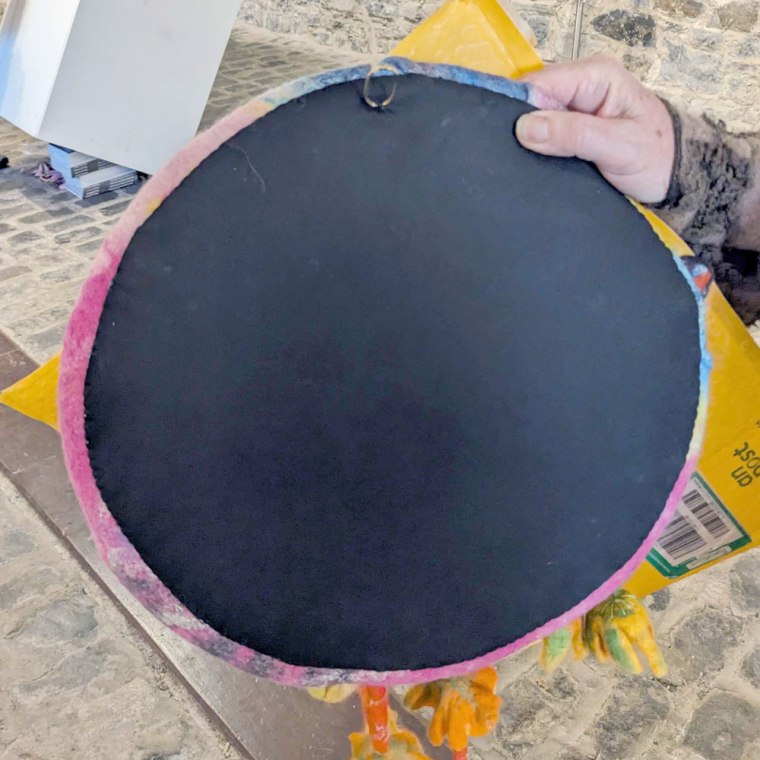
This example is round – your piece need not be square! It has a metal ring stiched into the fabric backing. This piece is by member Aisling Hassett.
Many artworks are not framed—some are kept in shape with battens 1″ x 1″, e.g., in a square behind the felted item. The battens may be nailed in place with small panel pins. A hook can be attached to the top batten for hanging. Alternatively, firm calico fabric, just a tiny bit smaller than the piece, can be hand-stitched to the piece. Then, the battens can be glued to the calico – e.g. with strong spray glue. Another option is to use iron-on, double-sided, adhesive Bondaweb to connect your project to a backing fabric. Again, a hook should be attached. {Please do not use spray glue directly on your felted textile as it may damage it.}
Framing
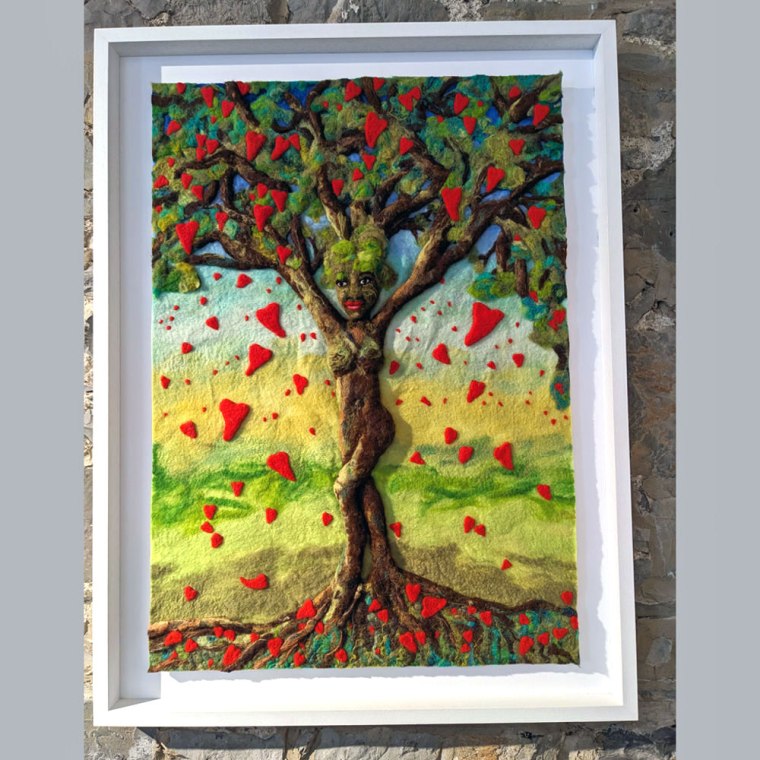
The front of Claire Merry’s piece which is boxed framed.
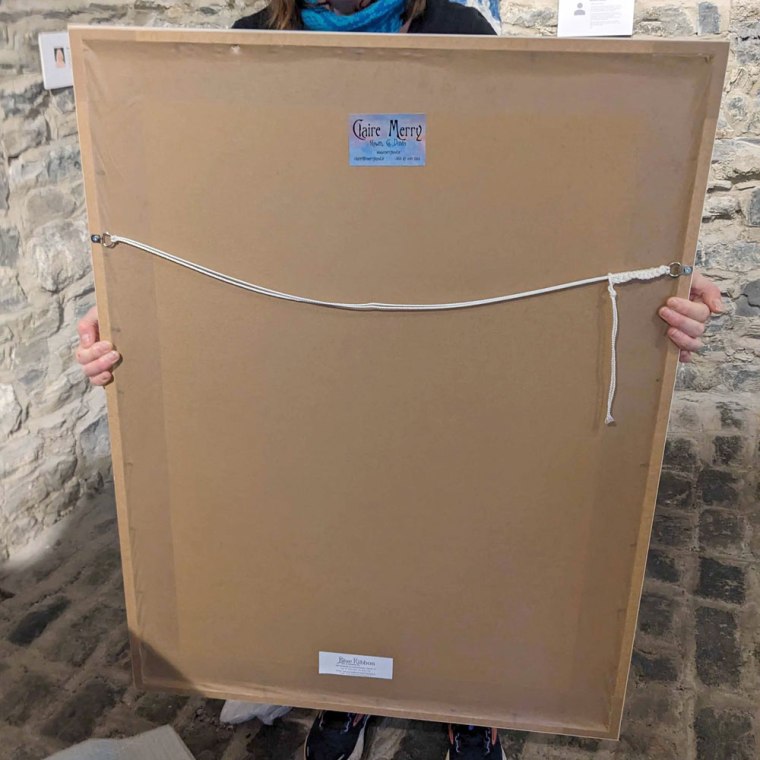
This example is an example of box framing done by Blue Ribbon Framing in Dublin. The piece is by member Claire Merry.
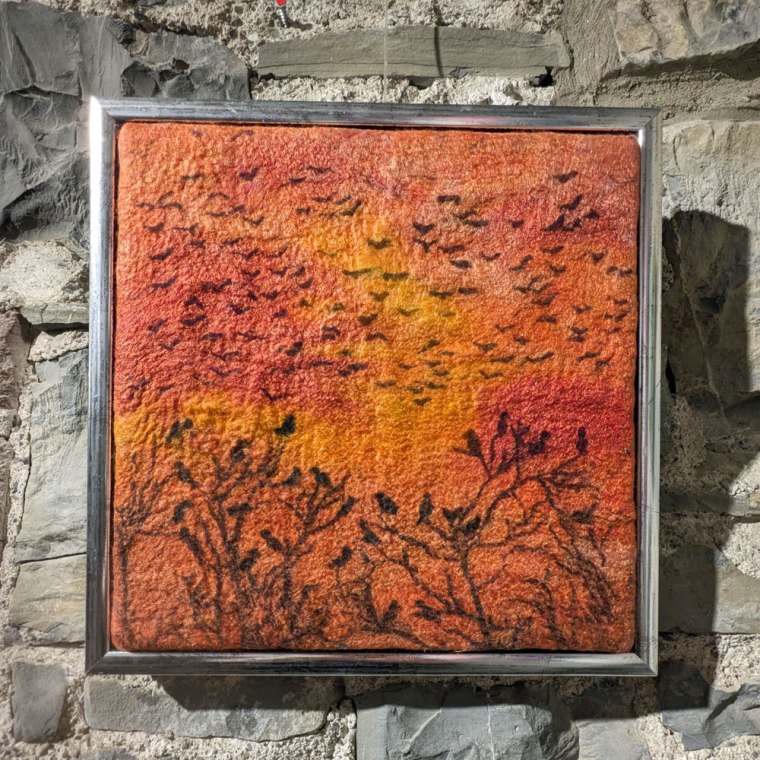
This framed piece has no glass and one can more easily see the textures. Piece by member Maria McGarry.
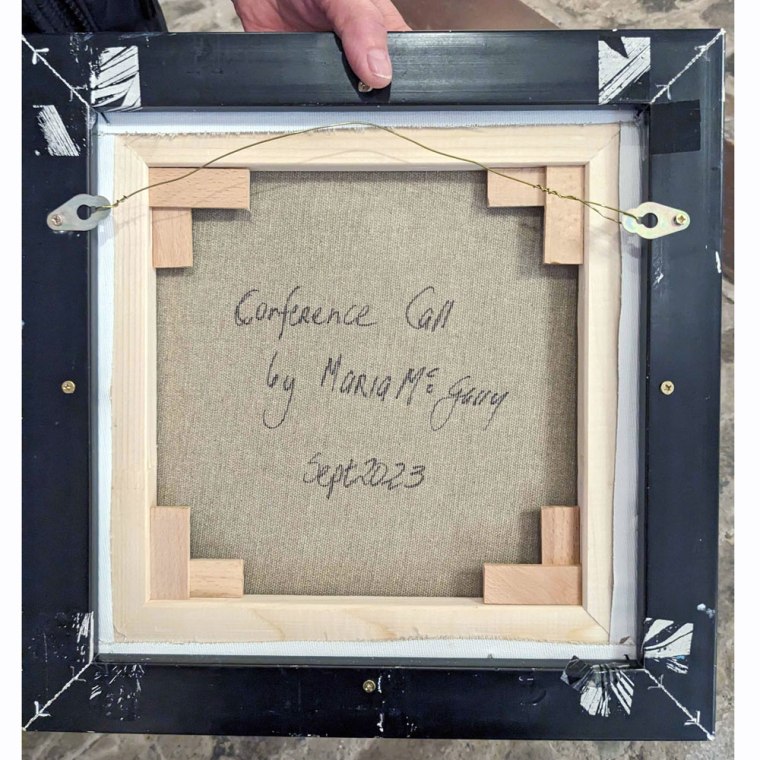
This back of this piece has a wire connecting to two metal brackets. It is also signed and dated. The artist is member Maria McGarry.
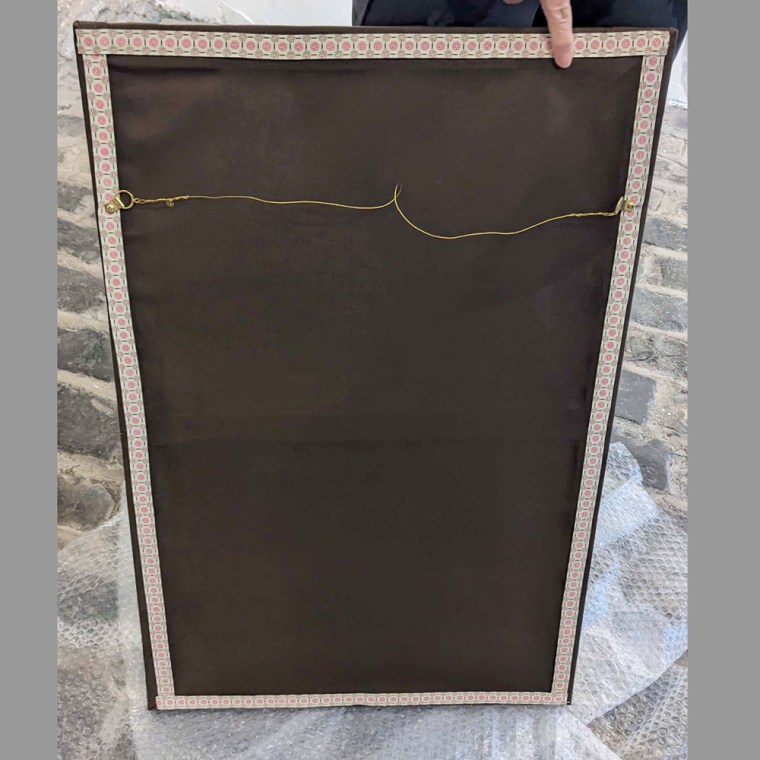
This piece has decorative ribbon covering staples and two metal loops and a wire. It is created by member Hélène Dooley
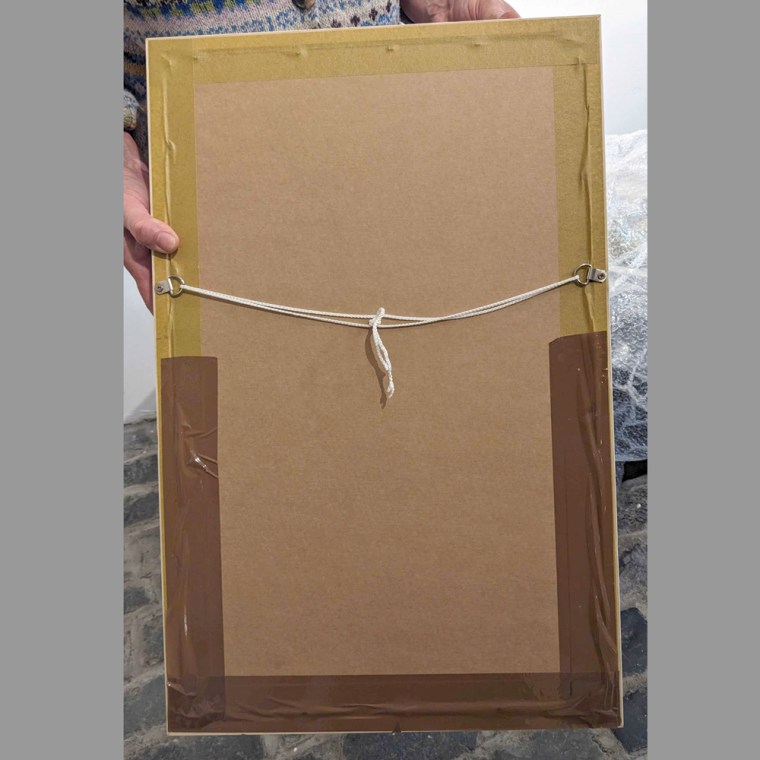
Back of frame showing two D-rings and cord.
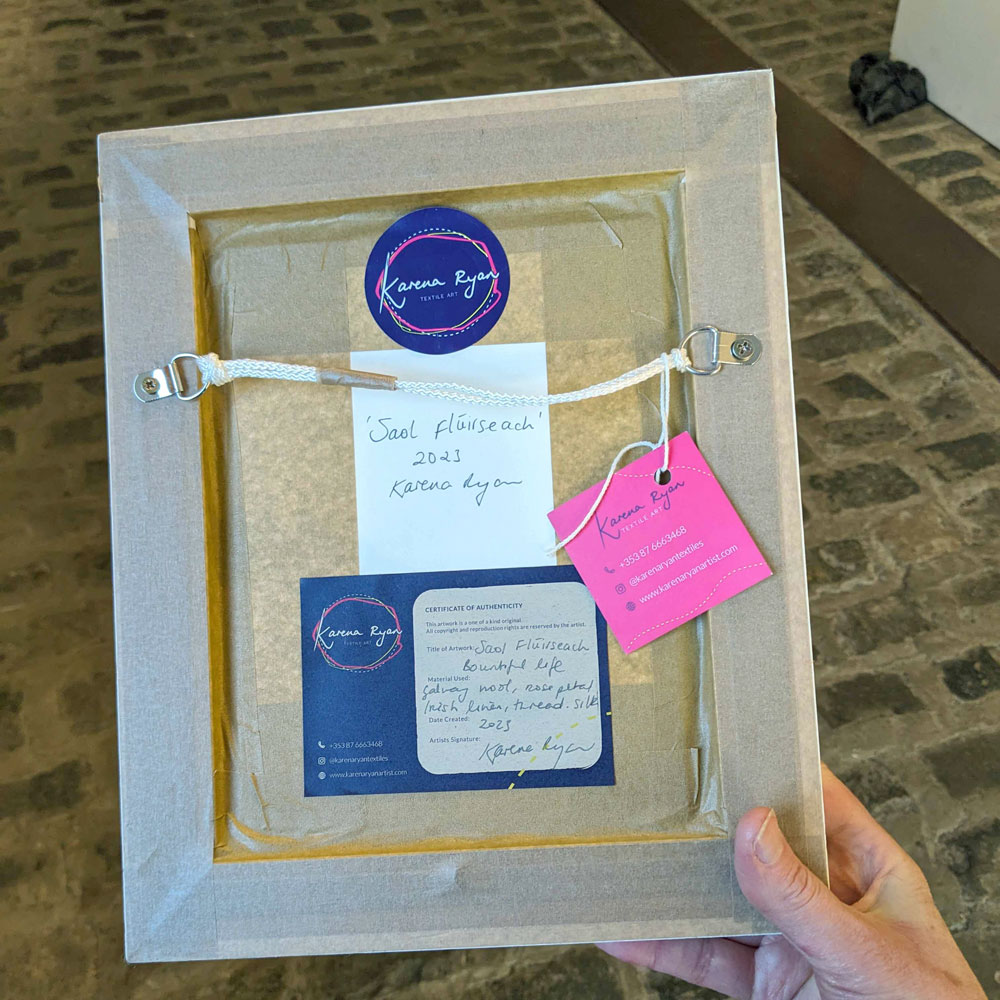
The back of this piece by Karena Ryan includes interesting additional information, along with a certificate for the customer.
a] Choice of frame In general, frames should be a bit larger than the piece to allow for a bit of a border and not have the actual edge of the felted piece squashed under the ‘rebate’ of the frame. Some people may have equipment at home, e.g., a mitre saw, to make a frame or order a suitable one from a professional framer. There are many ready-made frames in different sizes on the market or online. [One word of warning – in previous years of our exhibition, members have submitted pieces in IKEA frames, some of which sadly fell apart when hung up. It is perhaps best to avoid this brand].
If you want to frame your piece with glass [see below] – and the work is not entirely flat – a ‘box frame’ can be used. These are constructed with a box effect where the side panels are about 2-3cm deep – the glass is held at the front by various means, and the piece can be attached to the backing panel. It allows for a limited depth 3D effect, e.g. a flower, to be positioned without being squashed by the glass. You will see what they are if you Google the phrase ‘box frames’. They can be purchased from various places – including IKEA, but again, there may be issues with the stability of the frames from there]!!
You can enhance the frame by painting/staining/varnishing it in a matching or contrasting colour to your piece. Similarly, if you have a slightly larger frame with a backing card to which your piece is fixed, you can choose a colour to complement both the piece and the frame.
b] Glass – or not The advantage of glass is that it protects your piece. The disadvantage is that when photographed, light may be reflected onto it—by flash, sunlight from the windows, or even overhead lights. Glass can spoil the appearance in photos, both when you initially submit your piece and if visitors to the exhibition want to photograph it.
One solution to problems with ordinary reflective glass is photographing your piece without glass.
The other possibility is to get non-reflective glass, which is available from most glaziers who do picture frame glass. If you take your frame along, they could cut it to size for you. It can be more expensive than standard glass and varies in price from place to place.
Some ready-made frames come with ‘plexiglass’, which is used because it won’t break if the frame falls. If you have a frame made of this material, you might find it is less reflective than ordinary glass.
If using glass of any type, always ensure the piece is COMPLETELY dry if it has been wet felted. It is best to not even to breathe heavily on the felt – residual moisture could be trapped under the glass and cause the felted piece to GO MOULDY!
c] Internal illumination of the exhibit The amount of natural light in the Phoenix Park Visitors’ Centre is good. Plus, there are ceiling lights.
It may be that an artist would like to illuminate their work from behind, e.g., in a box frame, if the finished effect was lacy in appearance and would benefit from this. In the last couple of years, no one has submitted a piece like this, but here are some points to consider: It is best to use a box frame so that the lighting device can be hidden behind the felt piece. An LED device should be used [rather than a ‘normal’ bulb] as this would not heat up – much safer! Also, an LED with mini batteries would not need to be plugged into a power socket – there may not be one conveniently located within reach, and there would be no problems with trailing wires. The LED unit should be totally out of sight behind the felted piece. The ‘lit’ exhibit could be hung or placed on a plinth. {Editor’s note: There are few electrical outlets in the gallery}.
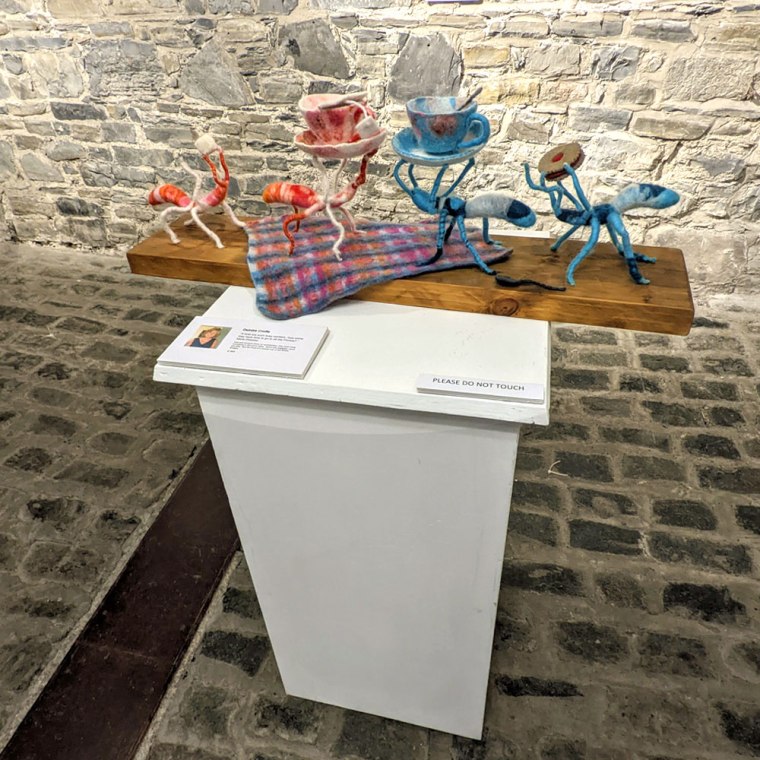
Artwork which will not be hung on walls
An example of a sculpture. This piece was created by member Deirdre Crofts.
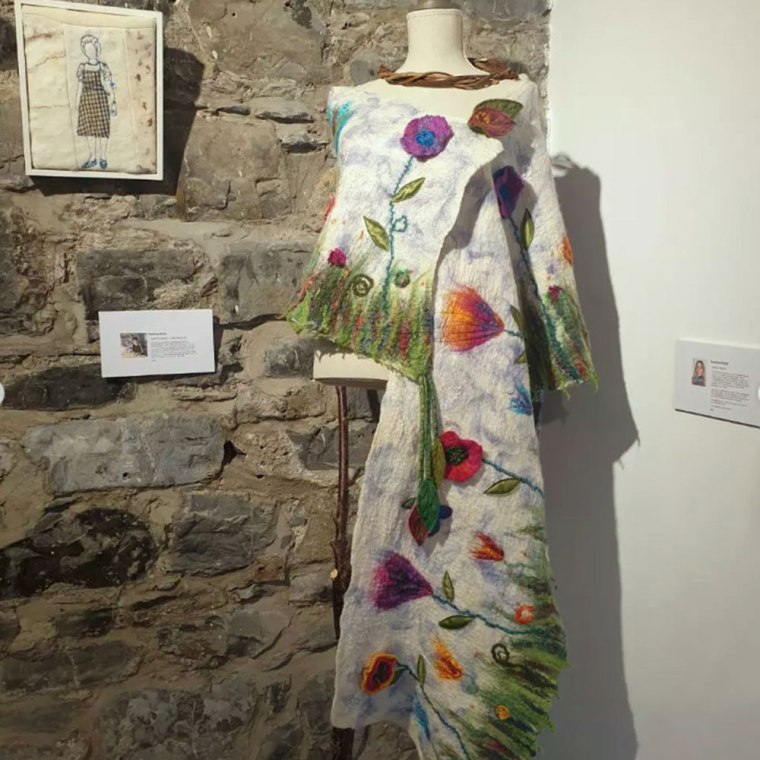
Example of dressmaker’s dummy to display art. Nunofelted shawl by member Mel Bradley.
Another dressmaker’s mannequin. This one has branches at the base, which gives a sculptural effect. The felted wrap was created by Caoimhe Tuthill.
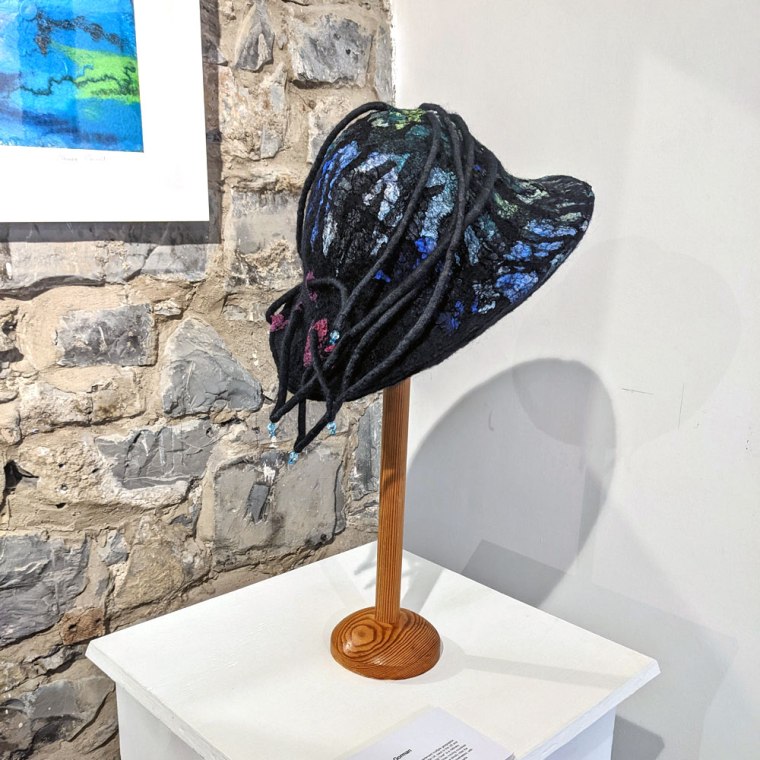
Display hats on a hat stand. Hat by member Juliane Gorman
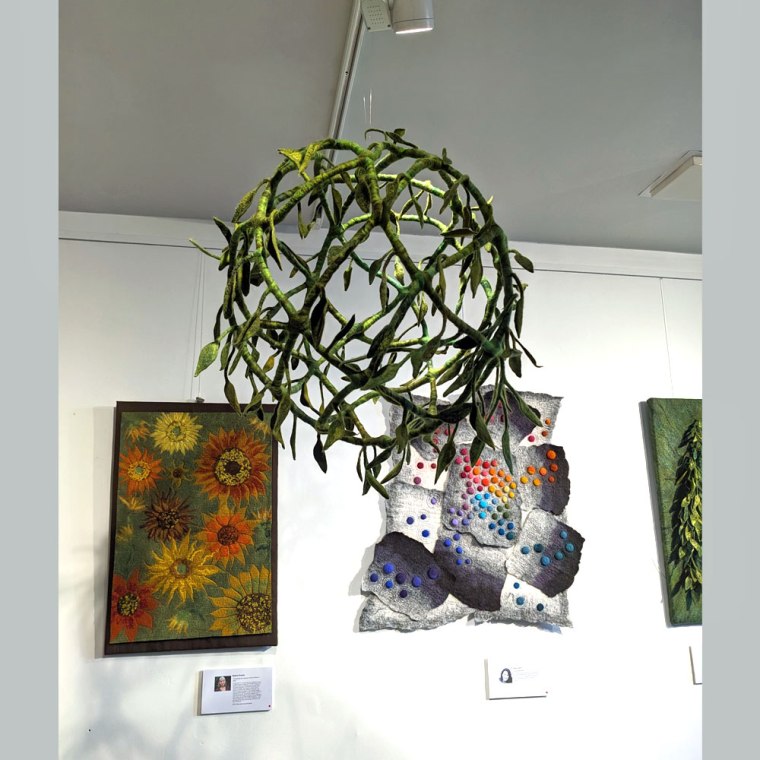
An example of a suspended sculpture. Artwork by guild member Annika Berglund.
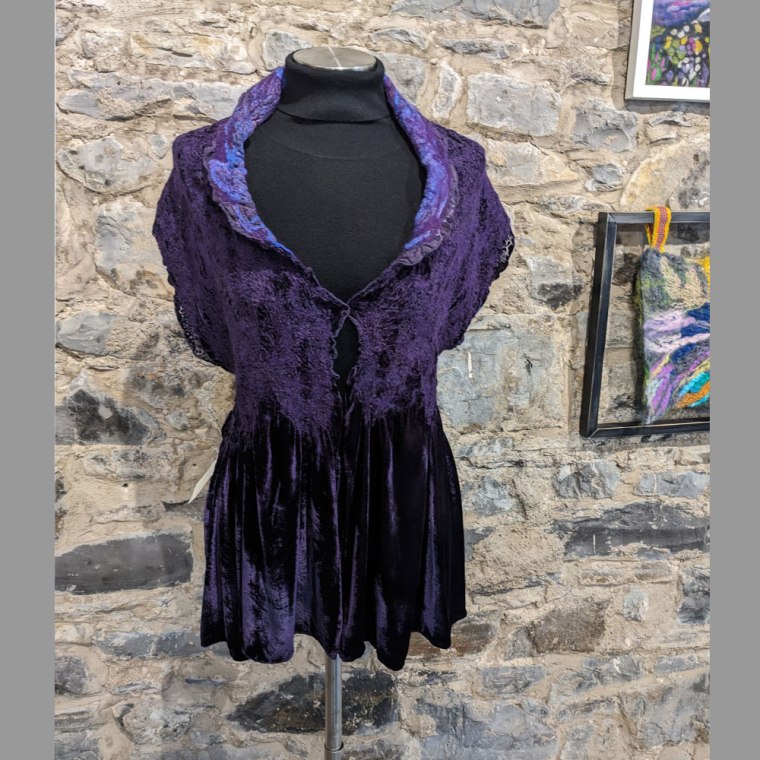
Some pieces must be displayed using methods other than wall mounting to showcase their qualities. Sculptures and wearables are examples of these types of work.
a] 3D items not suitable to hang, e.g., Sculptures. Several plinths will be available in the gallery, upon which three-dimensional items can be placed.
b] Wraps, jackets or coats are usually best displayed on a dressmaker’s dummy. If you do not have one, ask the committee, as it may be possible to borrow one.
c] Hats are best displayed on a stand – either set on a table, plinth or on a free-standing armature. Again, it may be possible to borrow one from the committee or other guild members.
d] Lastly, two or 3D felt installations can be hung from the ceiling – allowing space.
Lorna Cady March 2024
Feltmakers Ireland has an annual exhibition at the Phoenix Park Visitors’ Centre. This year, our show will run from Saturday, the 4th of May, to Sunday, the 26th of May, 2024. This year’s theme is ‘Opposites Attract’. All members are welcome to apply to the show. Applications can be found here – https://feltmakersireland.com/annual-guild-exhibition-submission/
The deadline for submitting your application is the 19th of April.
Editor’s Note: The photographs shared above come from the Guild’s two past exhibitions, ‘Bountiful’ from 2023 and ‘Building Bridges’ from 2022.
Disclaimer for Feltmakers Ireland Blog
Feltmakers Ireland aims to share information about awards, education, events, exhibitions, and opportunities that you will find interesting. Our sharing is neither paid for by nor an endorsement of these individuals or organisations.
Contact Us: If you have any concerns about content, please email us at feltmakersie@gmail.com.
Questions: For questions about content, please follow the link to the organisation involved in hosting the event.


 Feltmakers Ireland