Recap: Sunday Session with Annika Berglund – Part 2 – Online Education

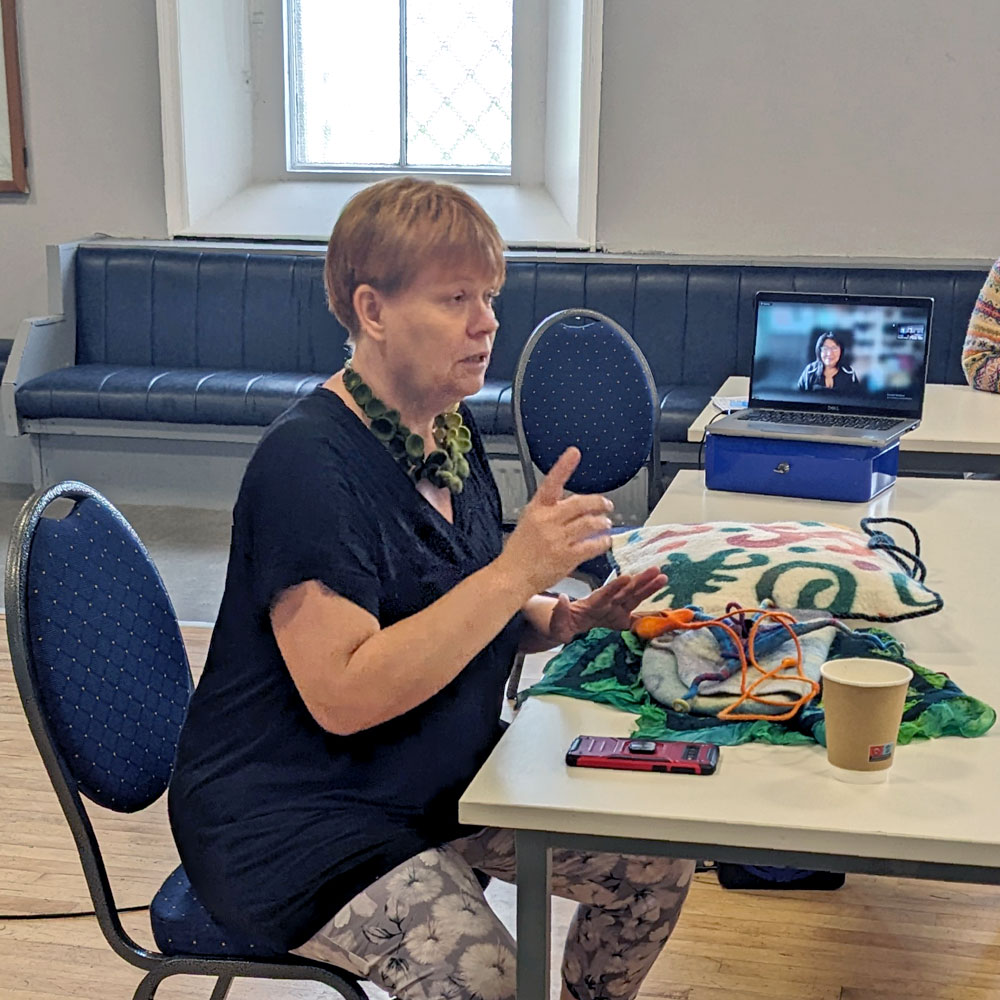
Annika at our October Sunday Session.

Member Annika Berglund shared her felting journey at Feltmakers Ireland’s most recent Sunday Session on the 8th of October.

Online Education

As mentioned previously, Annika started her felting journey with an in-person class at the 2019 Knitting and Stitching show. However, most of her textile learning experiences have been via online study. To read about her recent experience with the Hungarian Felting Retreat, visit this previous blogpost. This is a recap of her online education. Jump to the list of online classes.

How Information is Accessed

Annika explained how online classes are ‘delivered’, with many of the best ones being held on the Ruzuku platform, where new topics or projects are introduced weekly or bi-weekly. Depending upon the instructor, these classes can contain short videos, photographs, and step-by-step written instructions. This method helps to break down information into bite-sized pieces. Other tutors share their teaching via recordings of longer Zoom sessions. Typically, these classes are private links on YouTube. The drawback of this method is that students may need to fast-forward through a video to search for needed steps within the instructions.

Depending upon the teacher, classes can be for a few hours or for several weeks.

In some of the courses, students can upload photographs of their felted assignments. Seeing the work, the teacher and the other students in the class can offer feedback. Other students’ comments were an aspect that Annika appreciated through the isolation of 2020. Annika says, “When you did a course, {it} saved my sanity”.

Additionally, being a part of the worldwide felting community was a benefit of some of the courses. Lastly, courses offer one the opportunity to play!

Pam de Groot

The first online class that Annika took was taught by Pam de Groot, an Australian feltmaker.

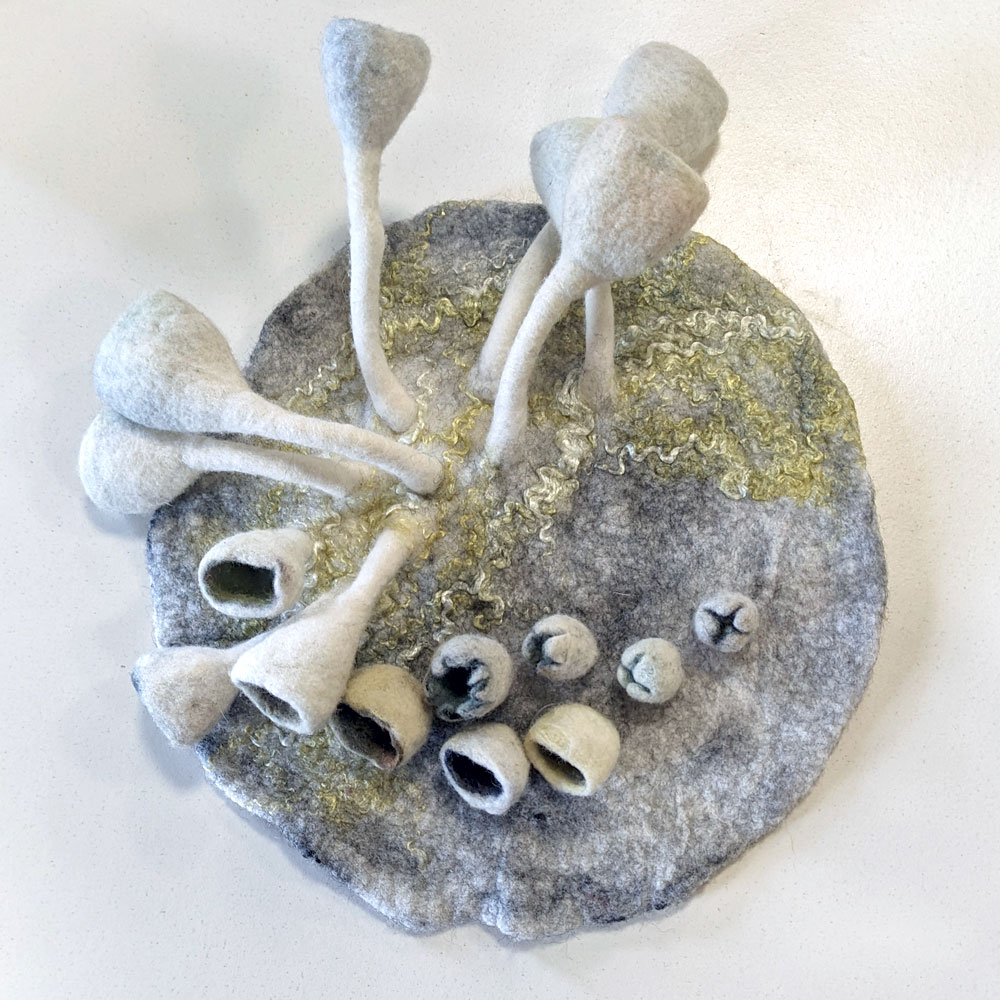
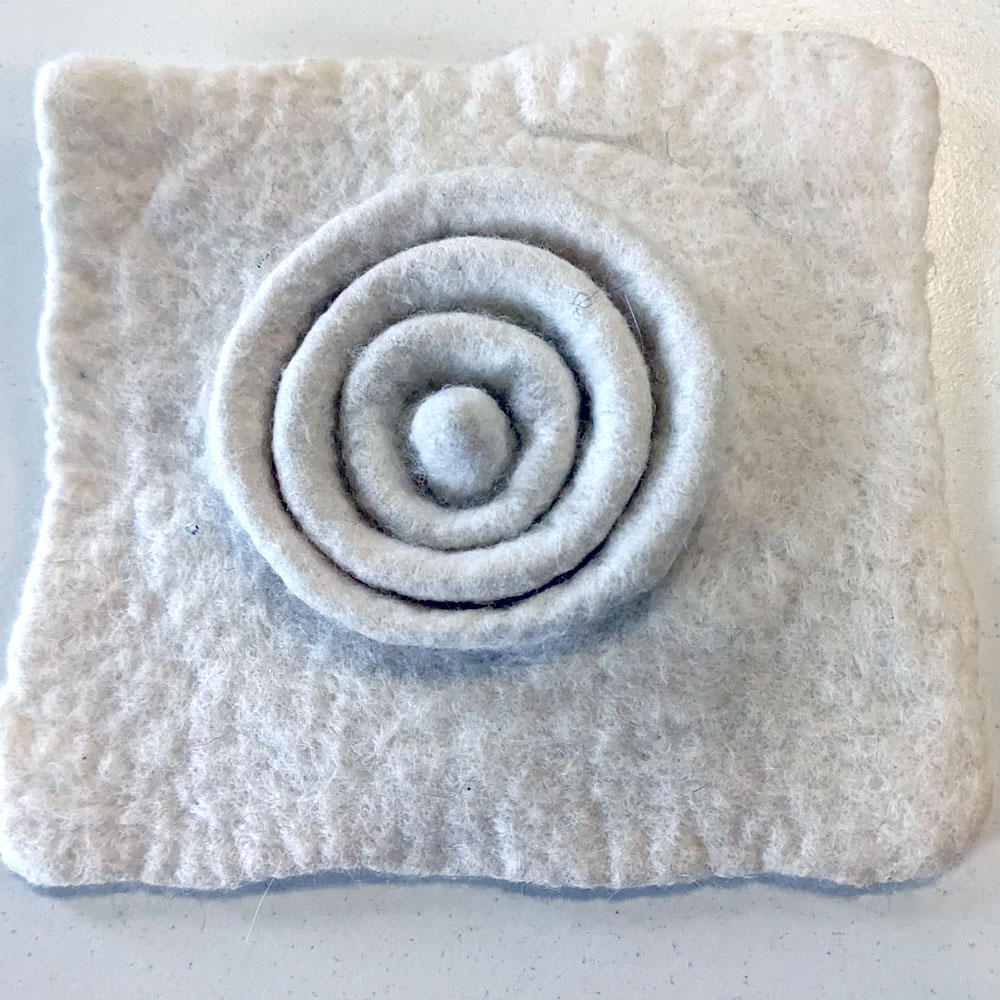
Pam offers two online courses. Annika greatly enjoyed ‘Surface, Form and Space’. It focuses on different types of differential shrinkage with each assignment. Pam’s other class, ‘Textures and Dimensions’, is more project-based, with multiple techniques in each project. Students create three three-dimensional sculptures: The Splash, The Spiral, and the Twistie. Annika’s Spiral project is the large white ‘seashell’ in the photograph below. While the teal-coloured, star-fish shape is from Pam’s other class.
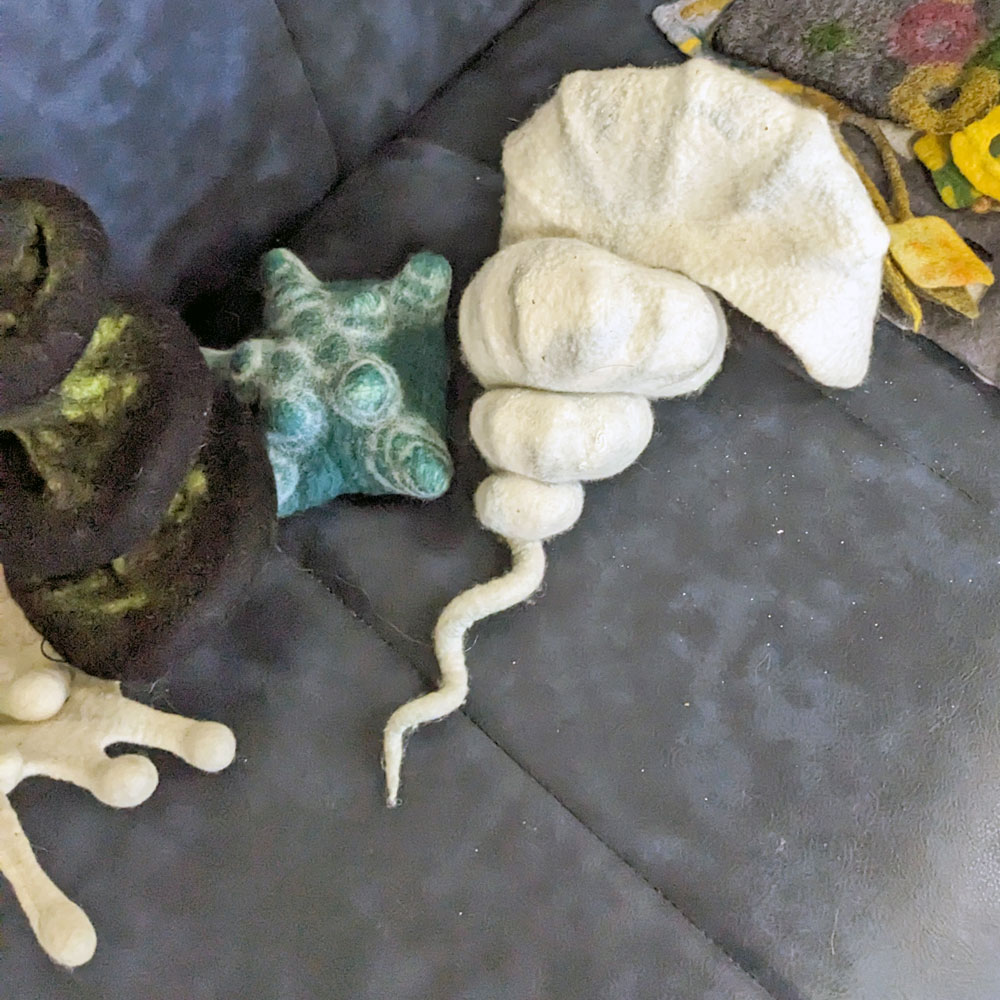
A medley of felted objects from Annika’s two Pam de Groot classes.

In May, at the AGM, guild member Ramona Farrelly won a bursary to attend a workshop of her choice. She chose Pam’s first class. You can read about Ramona’s experience on our blog.

Fiona Duthie

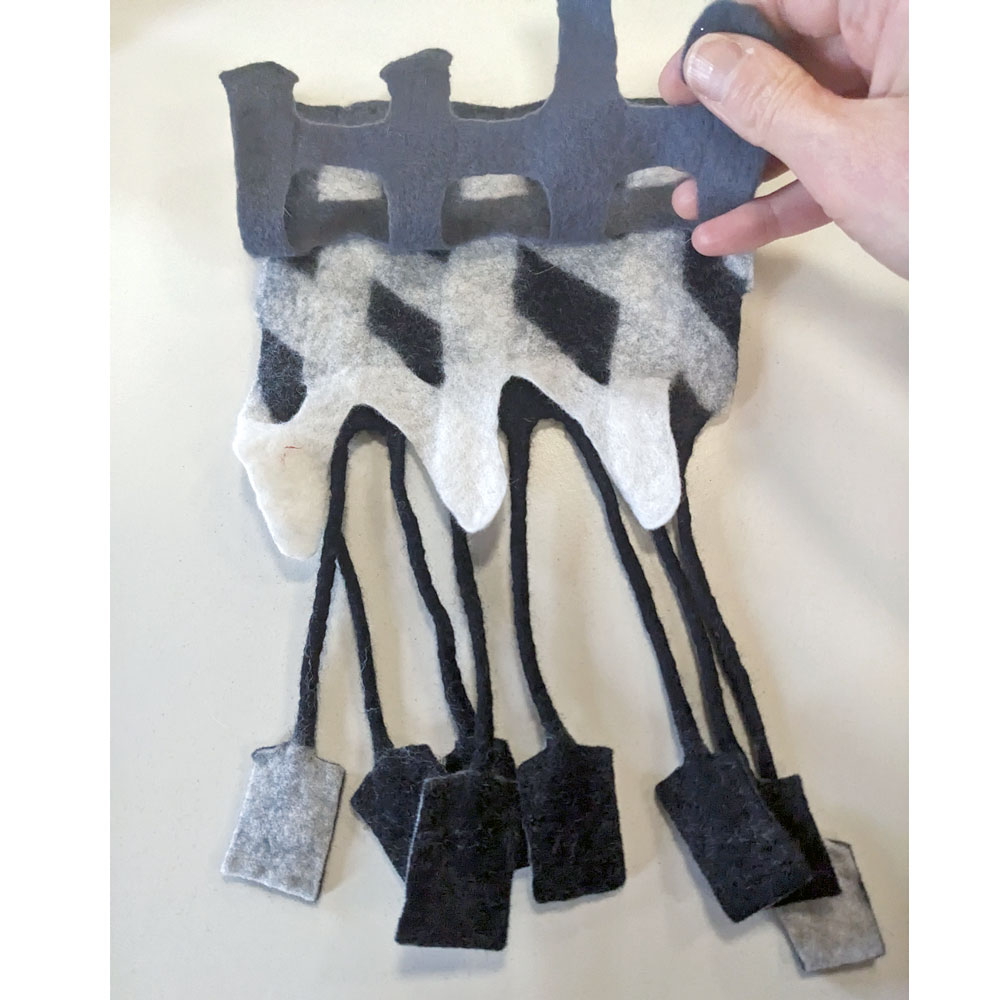
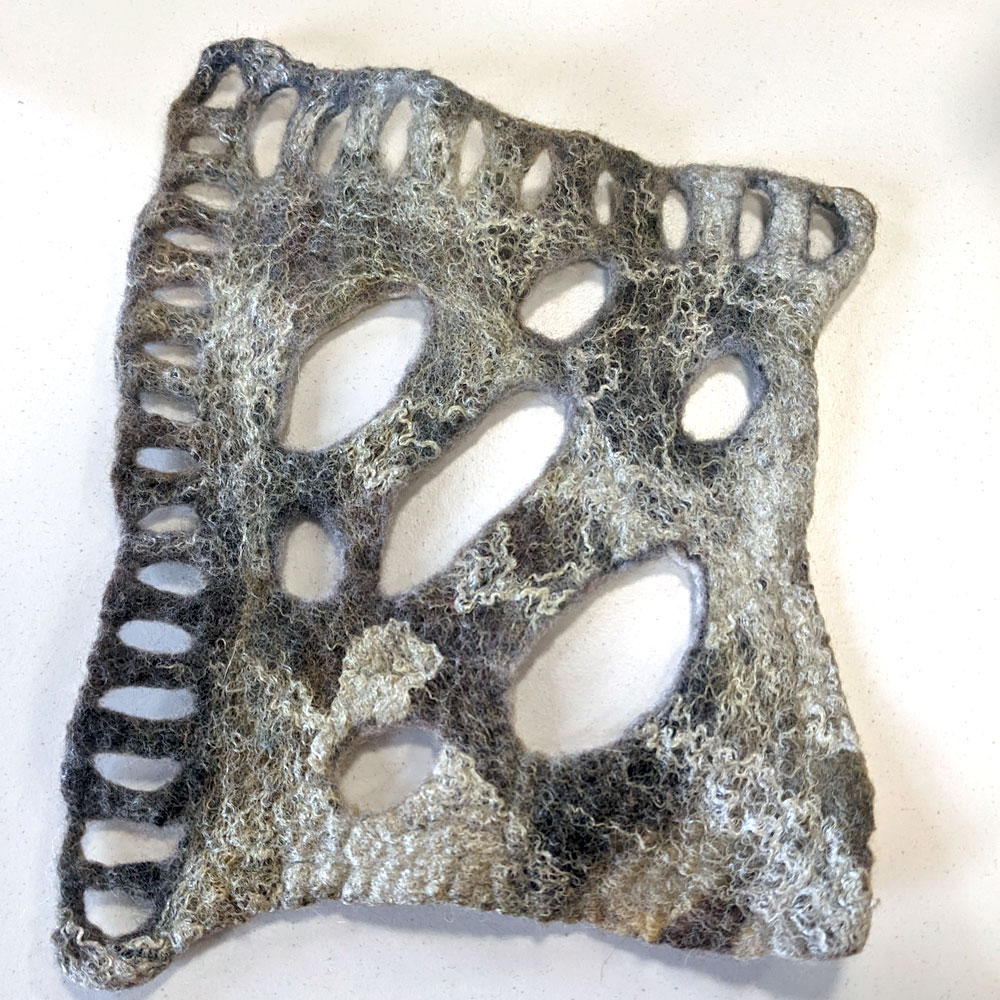
The next bunch of classes that Annika took were taught by the Canadian feltmaker Fiona Duthie. Fiona’s classes are so popular that they fill up. Hence, Annika could only get a spot in the ‘Over the Edge’ class. However, this eight-week class proved to be quite useful. As Annika says, it “was actually a really good one to do, because {there are} a lot of techniques in the one course and because of all these different ways to edge work, will teach you a lot of different felting techniques that you can use in the middle as well.”
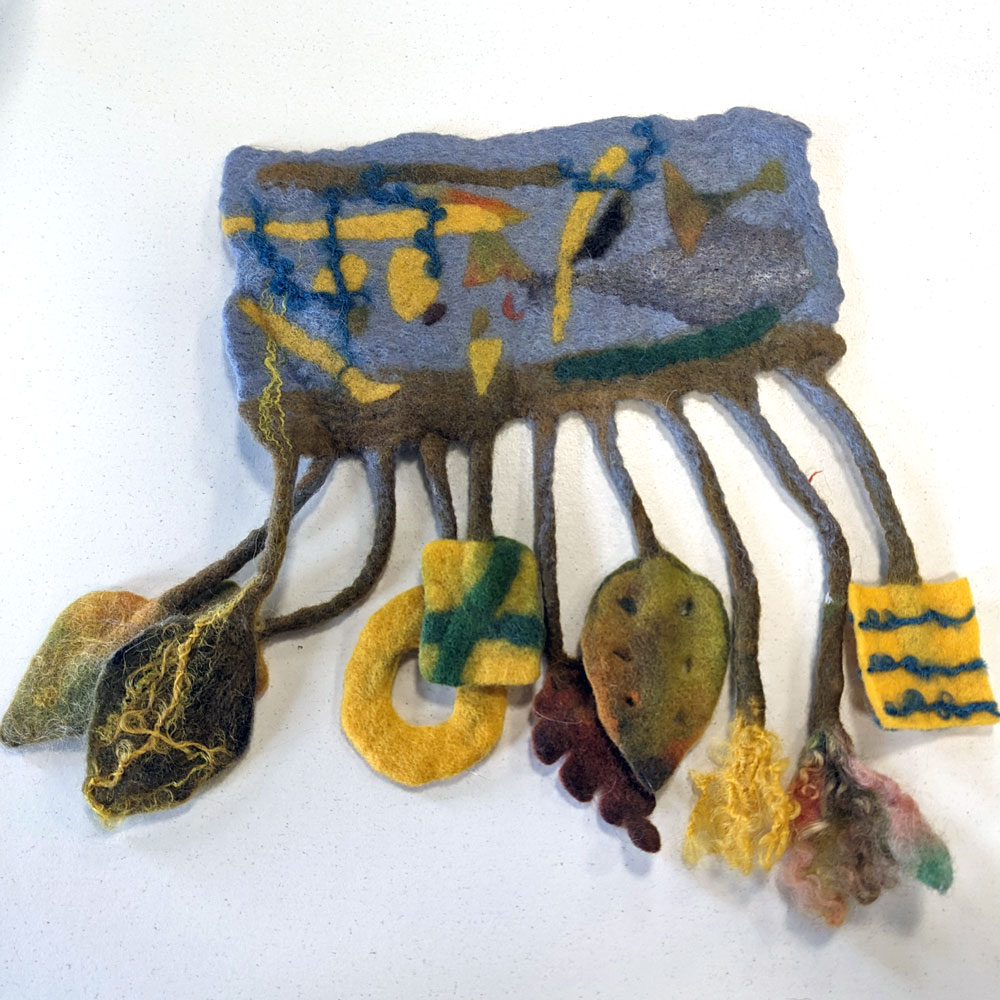
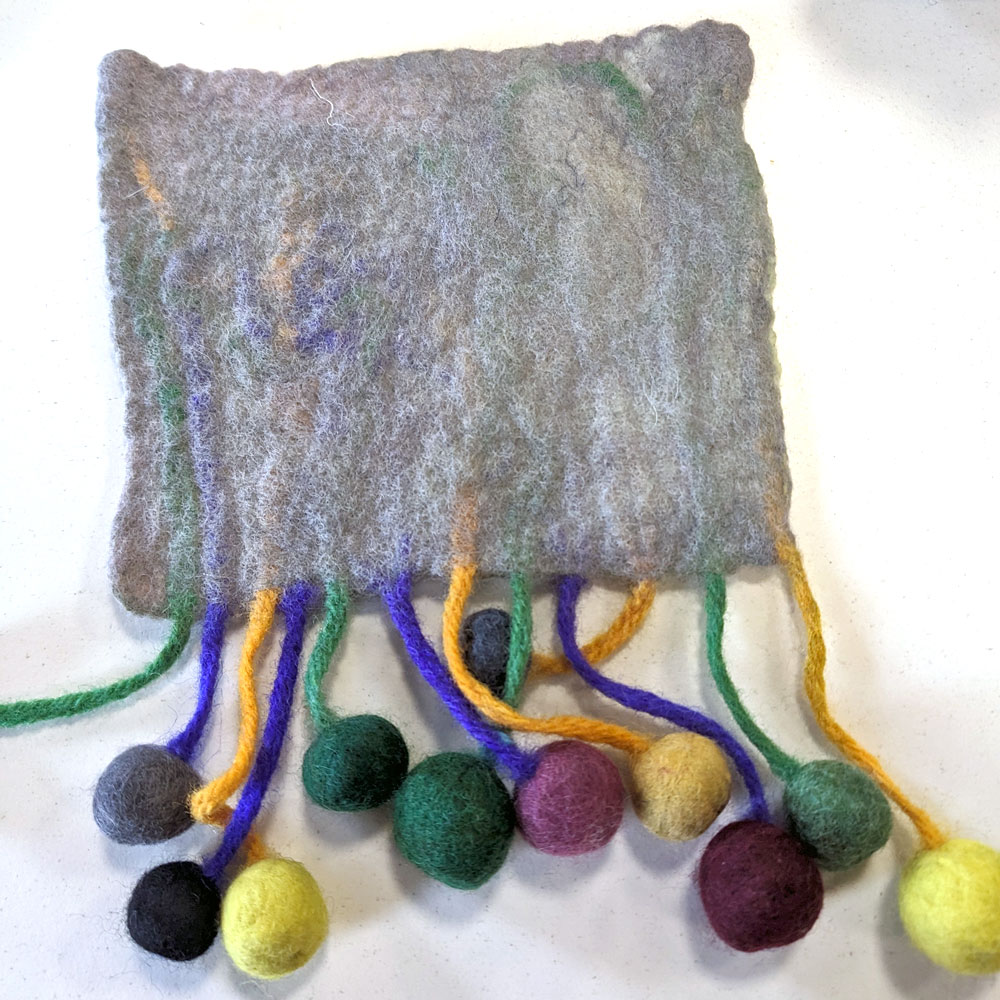
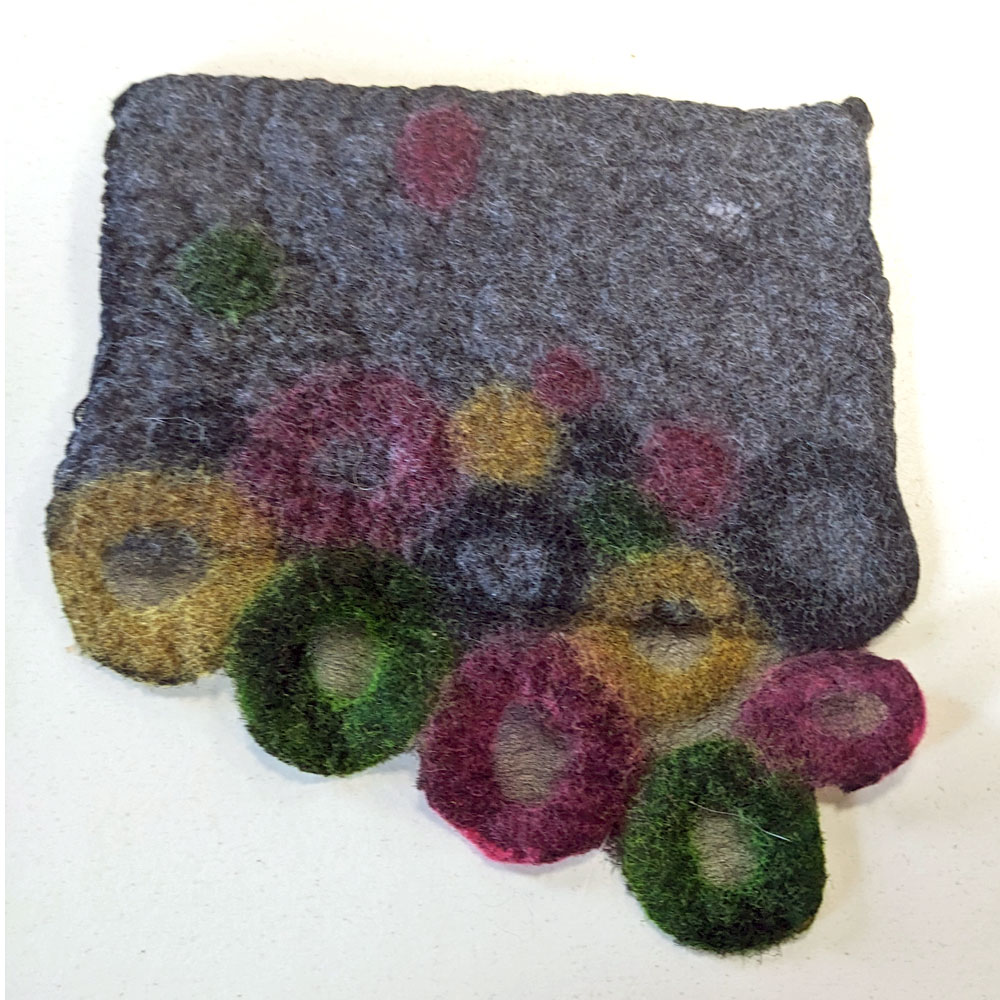
The next class that Annika took with Fiona Duthie was her ‘Raised Surfaces’ class. She found this class highly rewarding. She explained, “Once you start to attach things to the surface, you get much more lively stuff. And once you can do this, … then you can make a hat, or you can make a wall piece. So consider the techniques on their own, and then figure out how they fit with what you want to make…”
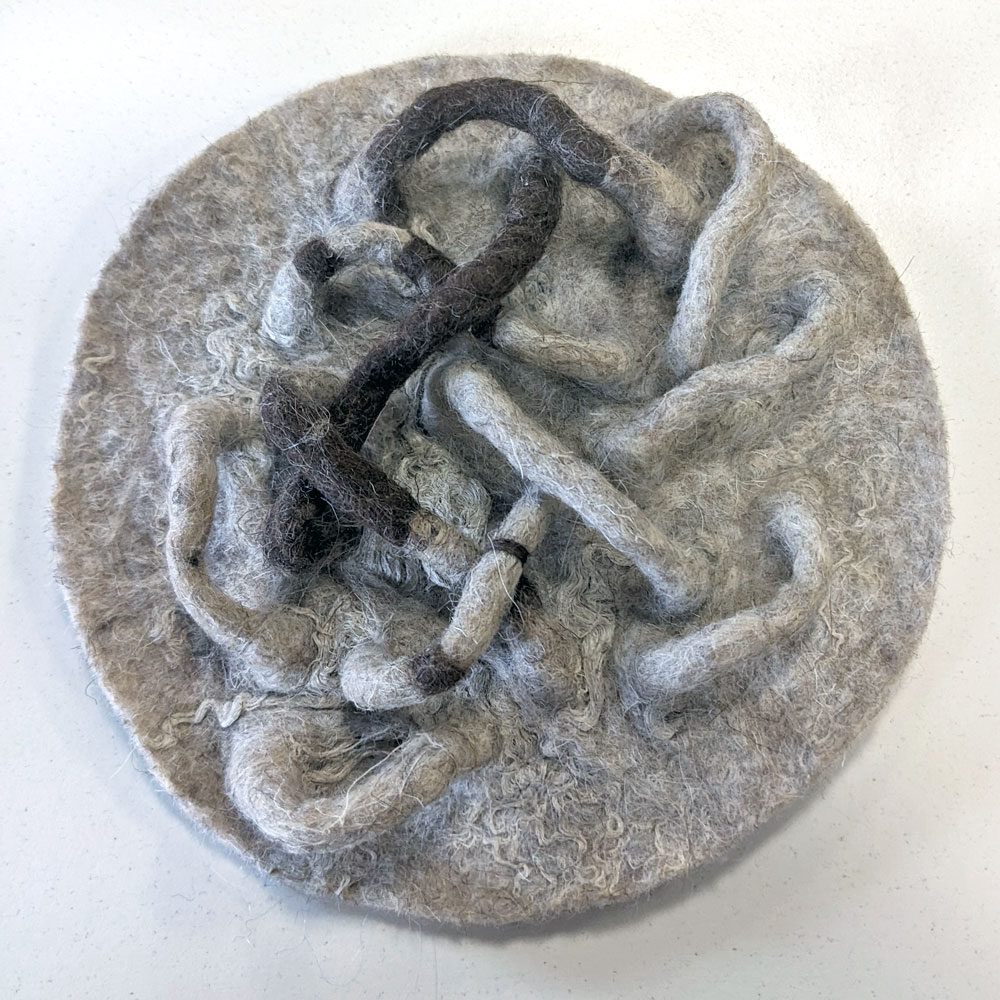
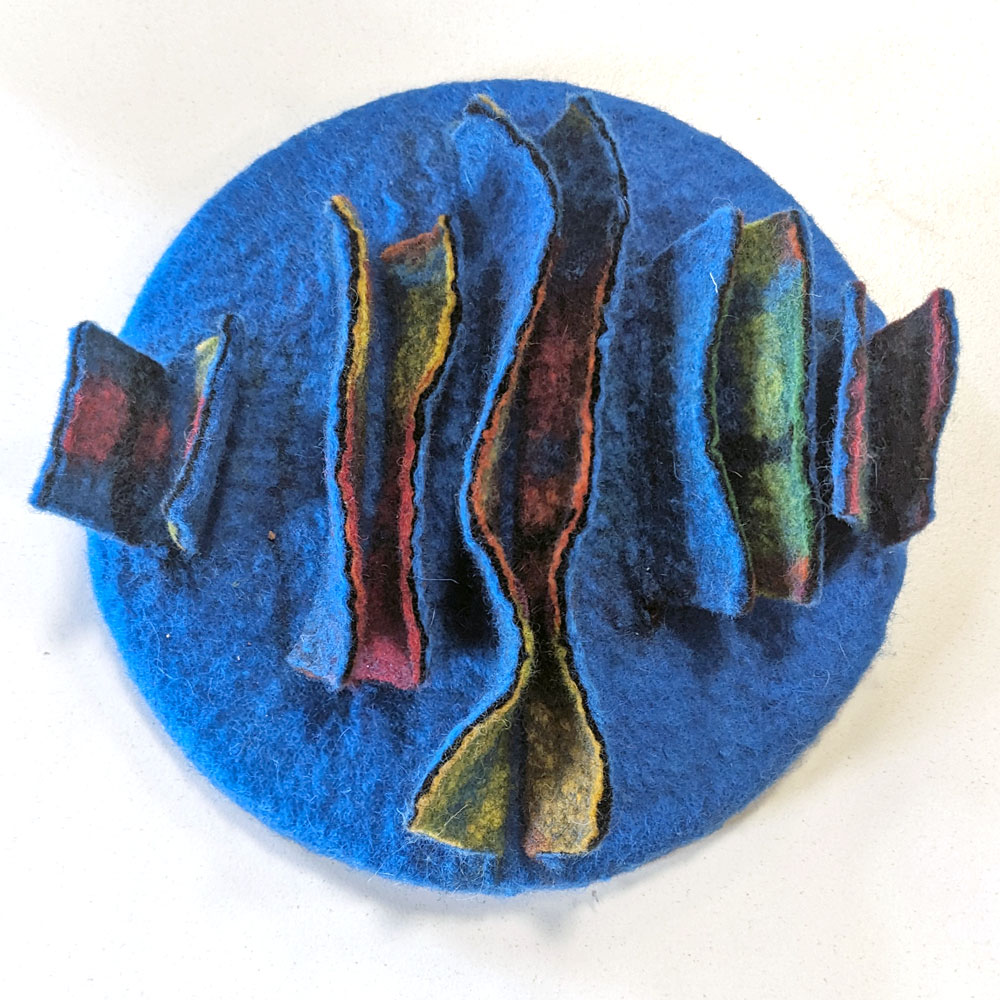
Another class that Annika took with Fiona was the ‘Fibre + Paper’ course. This class required gentle feltmaking, with students trying to coax wool through various types of fine papers, including mulberry. However, one of the benefits of working with paper is that it allows crisp mark-making. It also makes the felt stiffer so you can do more sculptural shaping. {In the past, Fiona has offered a related course where students learned how to create paper lampshades.}
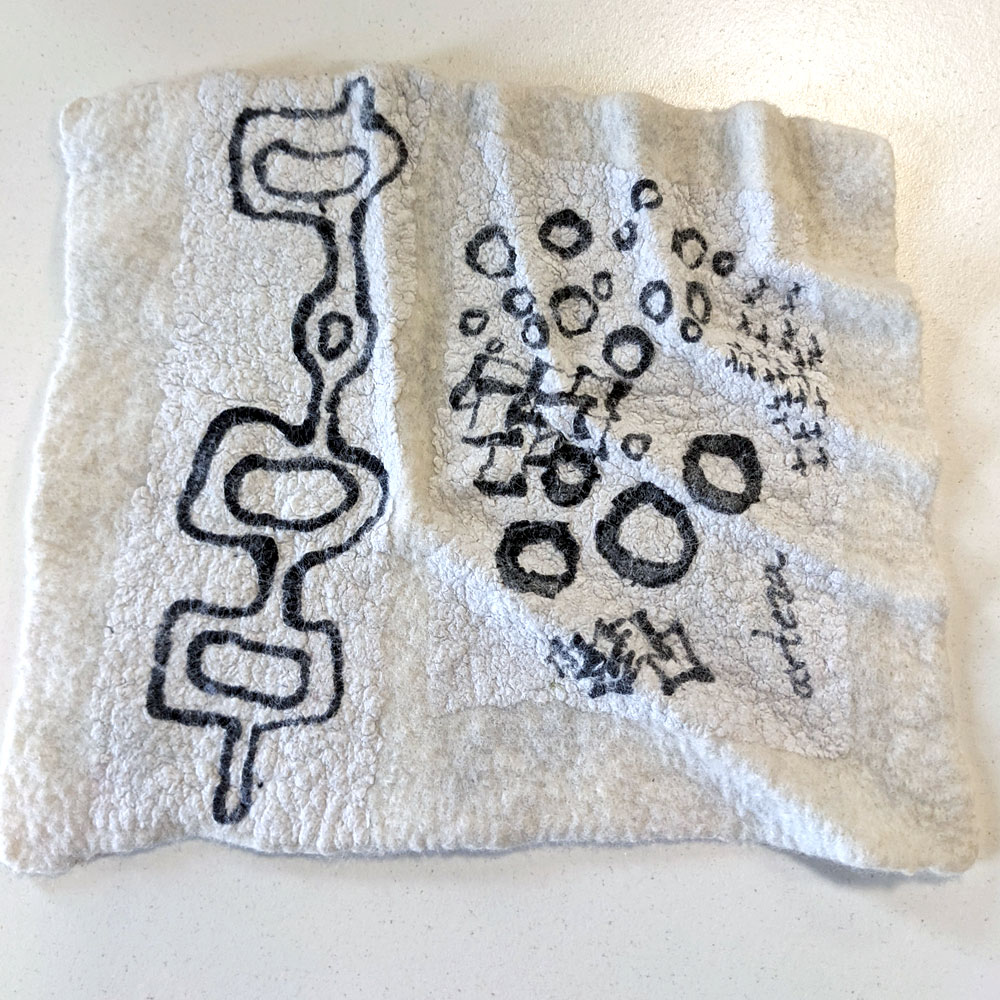
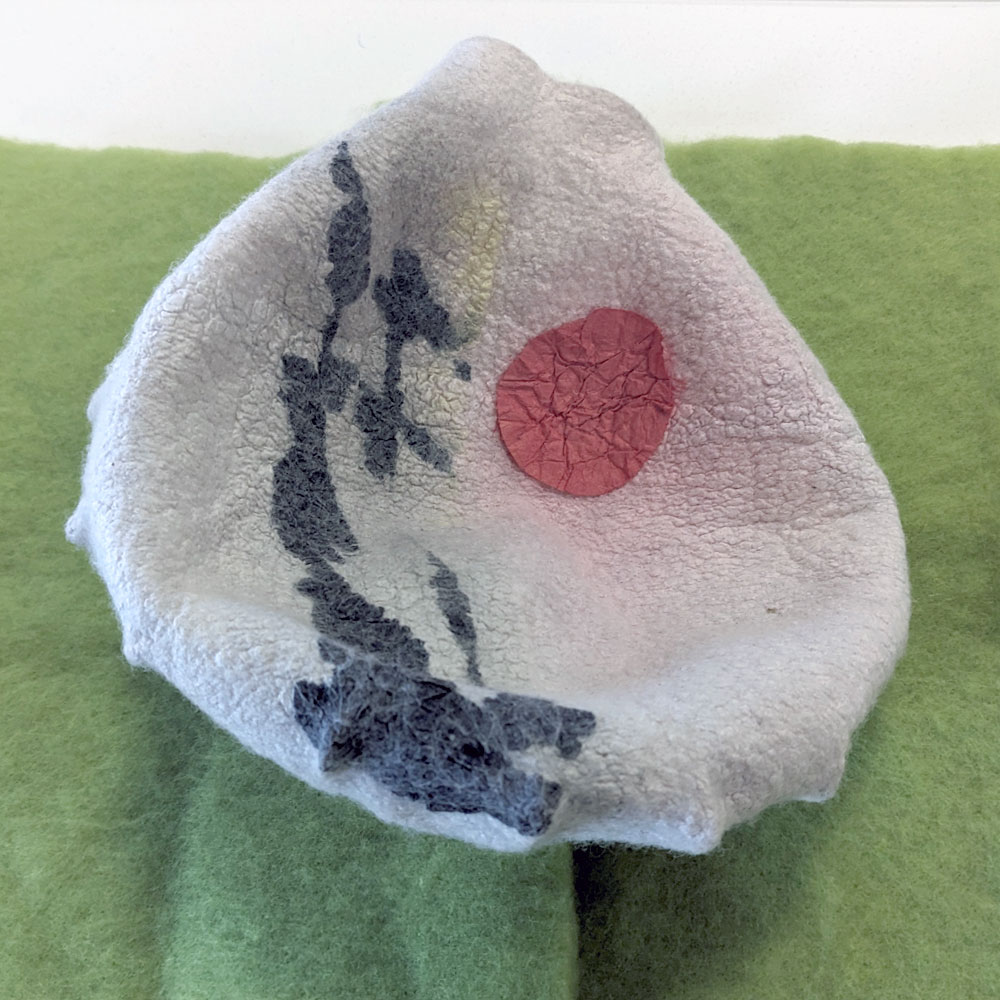
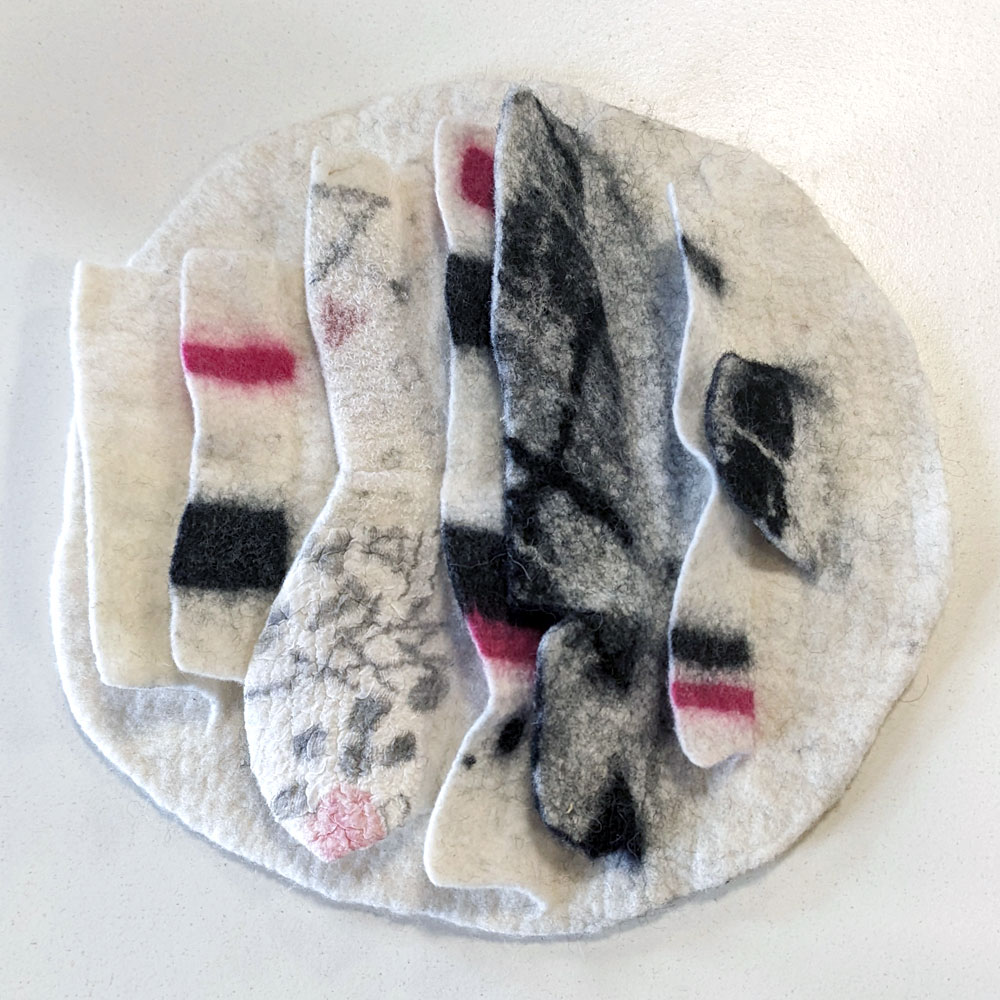
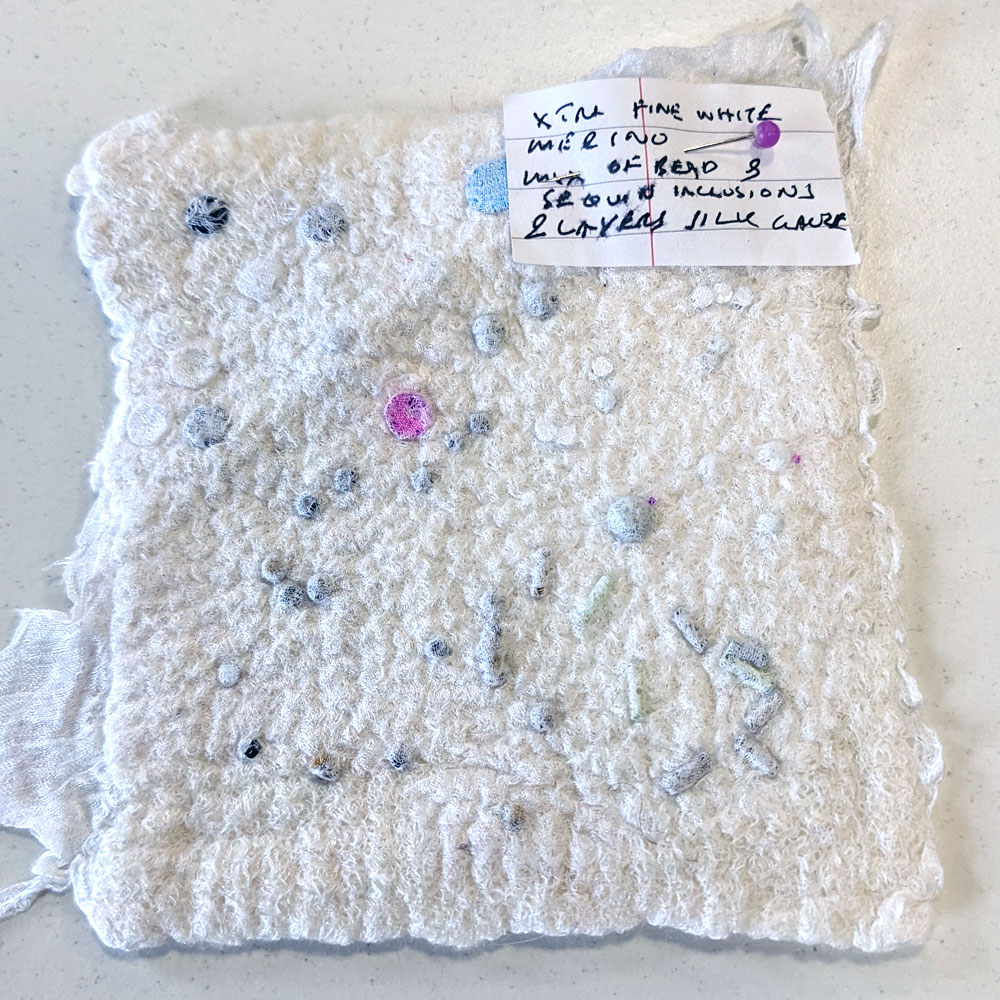
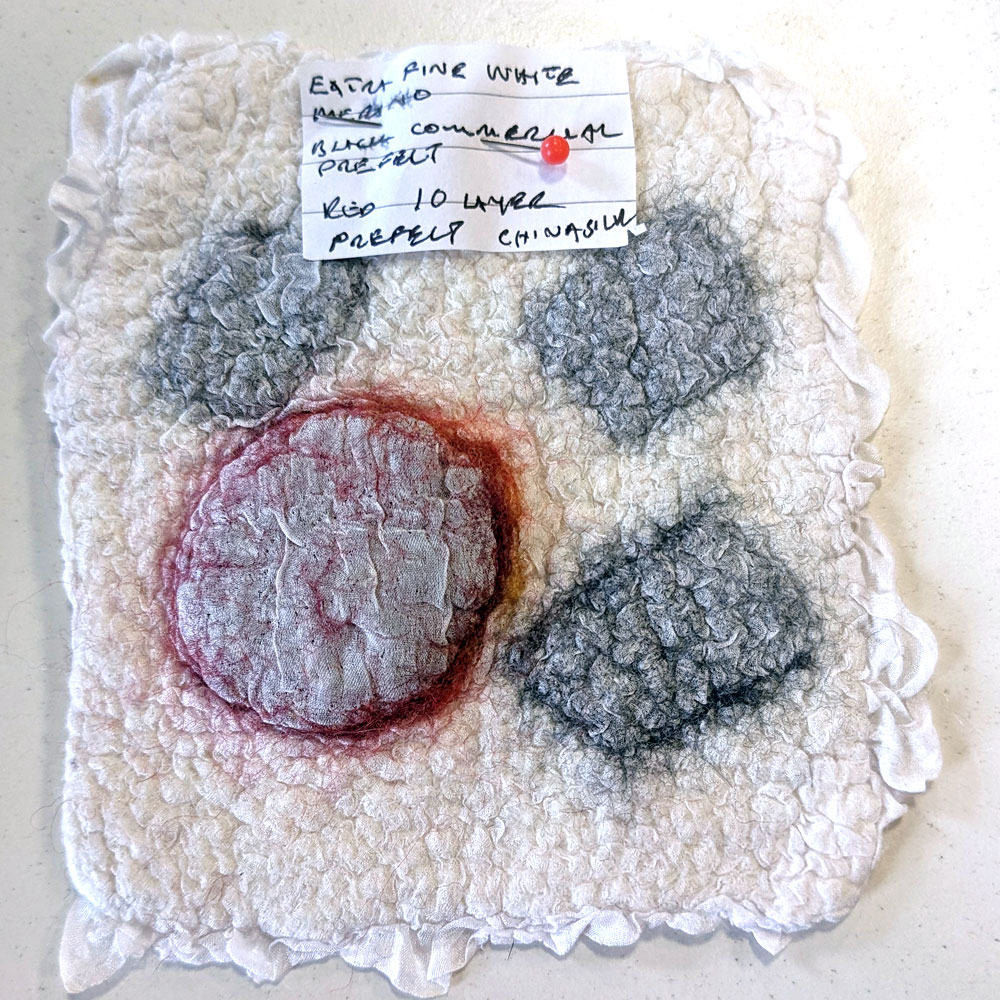
Annika also took Fiona’s ‘Surface Design Online Class’, which focussed on texture on flat surfaces. Note how Annika’s careful recordkeeping on her samples.

A Free Fiona Class

If students want to experience a Fiona Duthie class before first purchasing one, there is always her free online tutorial for a ‘Vessel with a Vessel’. This tutorial inspired the guild’s ‘Basic & Beyond’ class, which Annika taught at the beginning of 2023.
Mandy Nash

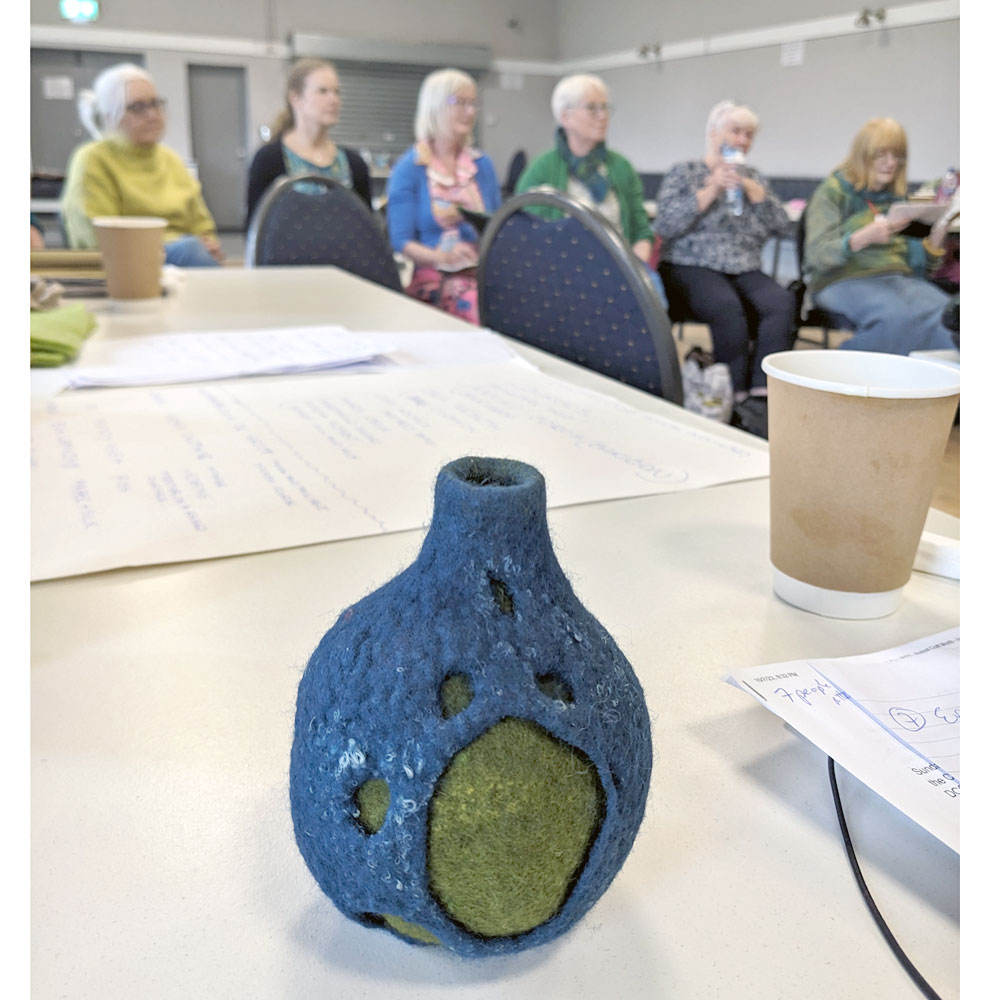
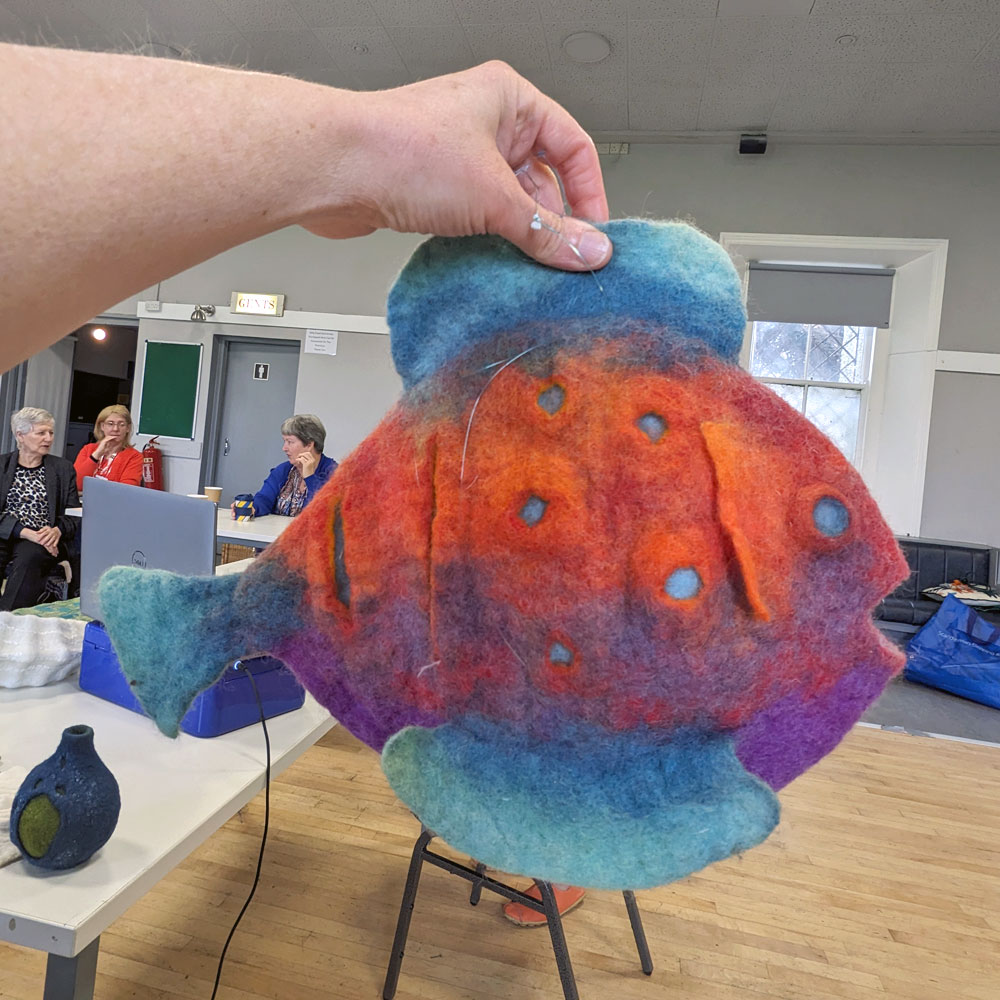
In this class with Mandy Nash, students learned how to make two felted fish during a live seven-hour Zoom workshop, which is now available as a recorded class. Mandy is UK-based and currently the president of the International Feltmakers Association. In 2022, she taught an in-person felted bag workshop to the Guild.
Eva Camacho

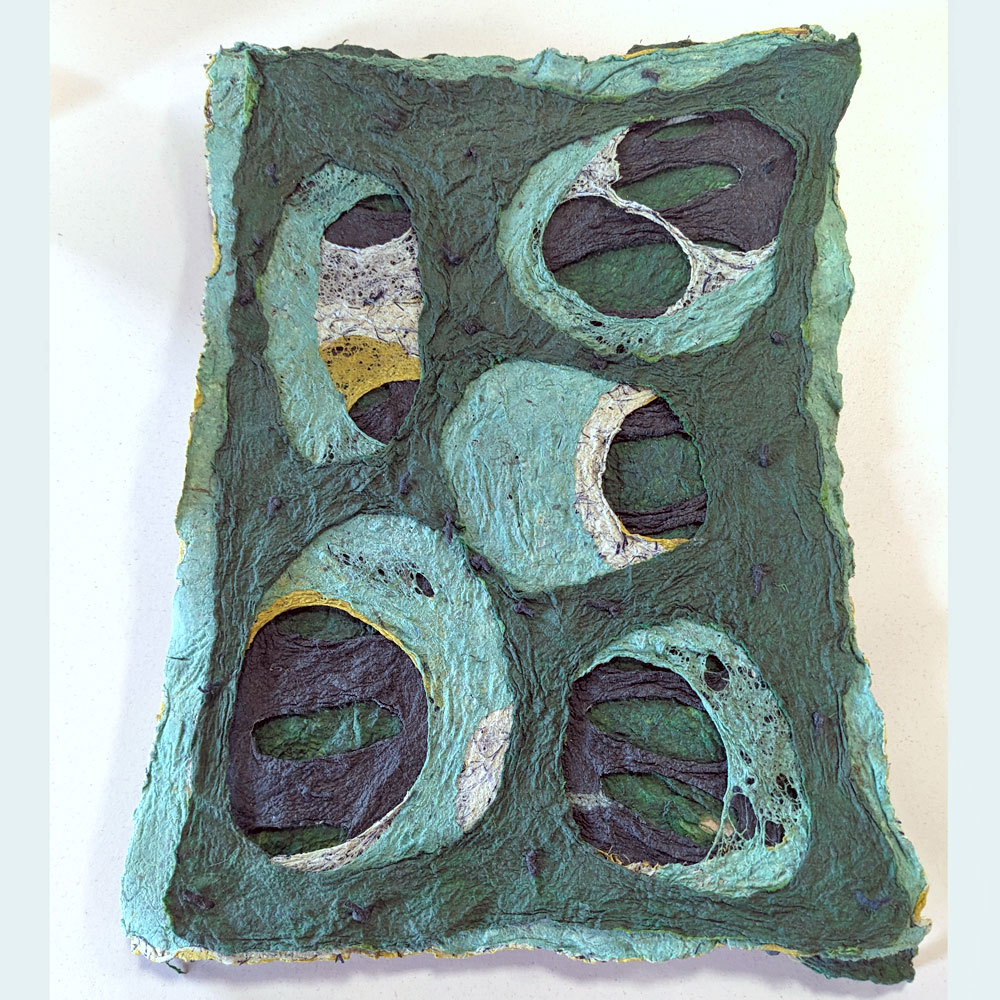
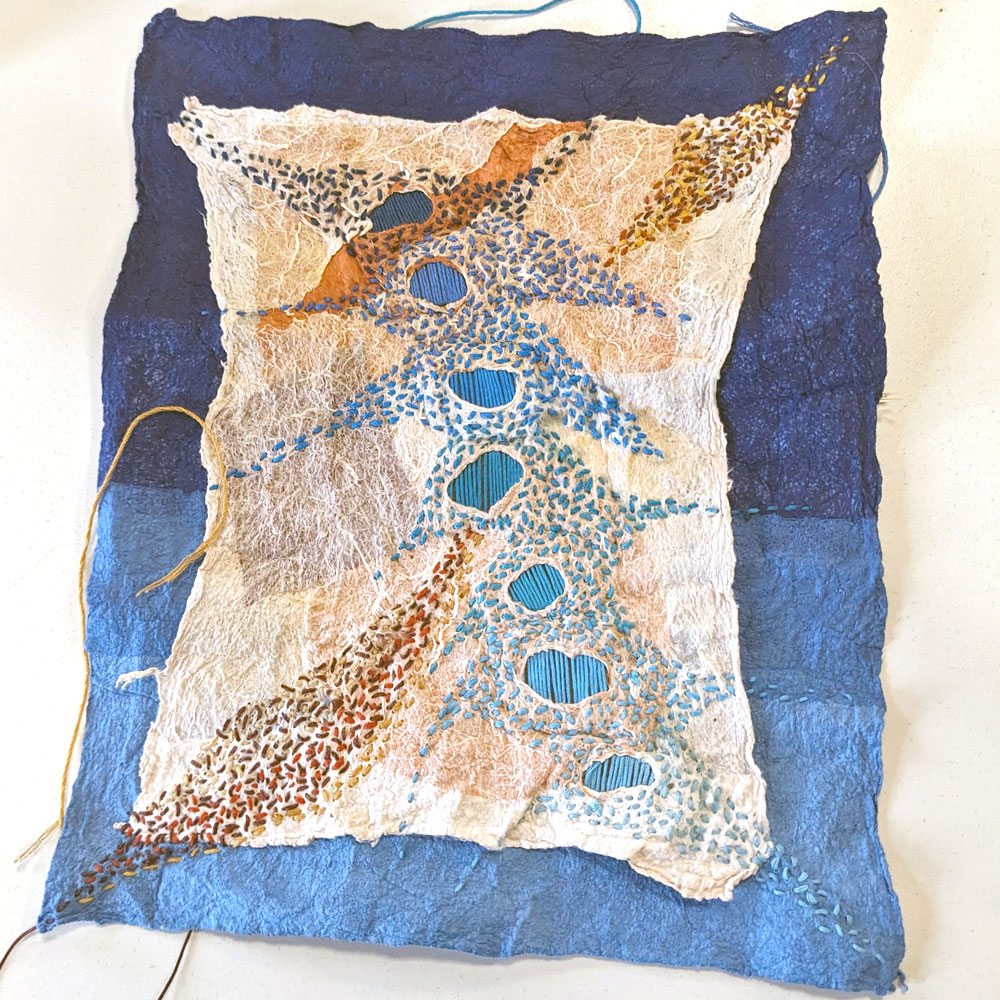
Annika particularly enjoyed learning from tutor Eva Camacho, a US-based feltmaker who is originally from Spain. Annika shared pieces from two of Eva’s classes. In one class, students used the Korean technique of ‘Joomchi’ to make projects out of mulberry bark. Annika explained, “Basically, Korean peasants couldn’t afford fabric, so they took mulberry paper and layered it.” The results were used for clothing and purses. The process is similar to feltmaking! She also took another class with Eva where students focussed on embroidering Joomchi.
Kristy Kun

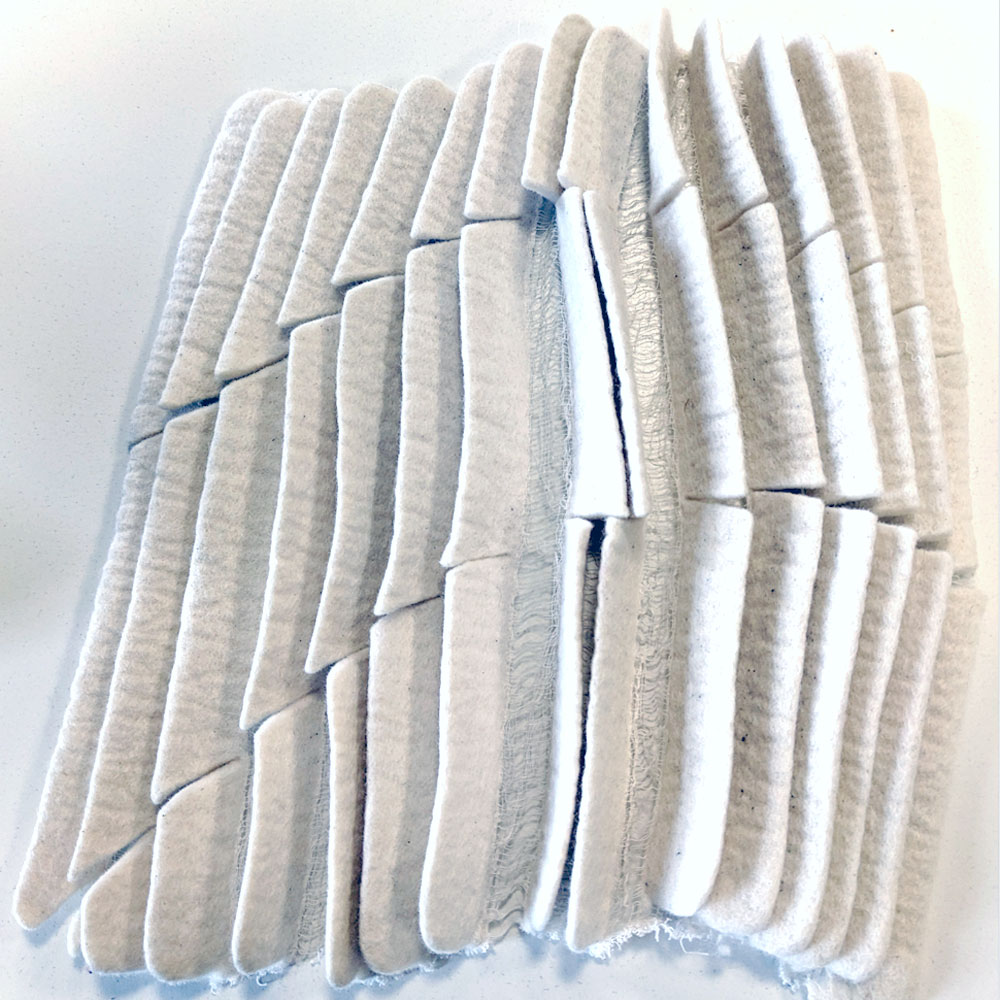
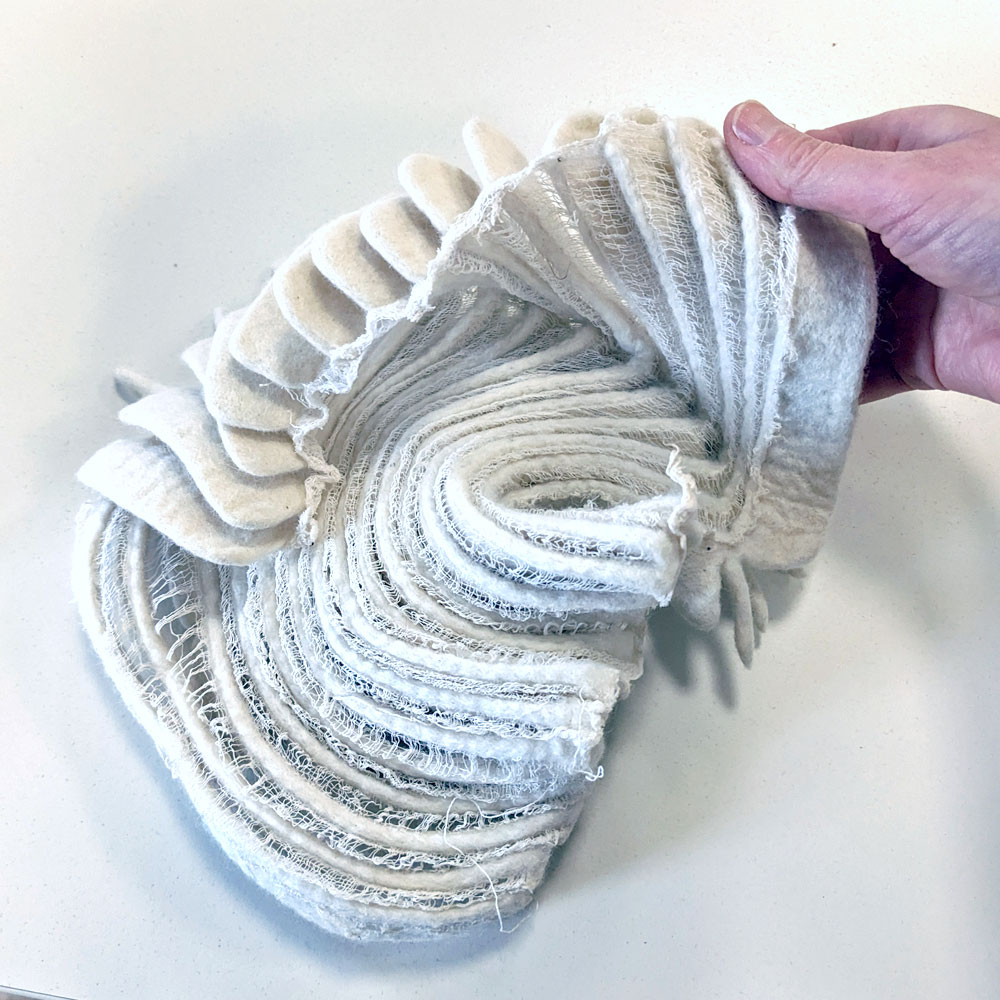
Kristy Kun is a US-based feltmaker who includes the supplies in the cost of her courses. As Kristy mails the supplies, Annika advises to keep this in mind when enrolling as there can be delays due to international mail. In these classes, Annika learned how to combine thick prefelt with thin cheesecloth fabric. She further explained the types of cheesecloth: it comes in a range of 90 to 10, with 90 being the densest. The loosest weave that she can find in Ireland is grade 50. She added that you can use cheesecloth for Nuno felting; it doesn’t need to be expensive silk fabric.

HERE is an article about the different grades of cheesecloth.
Molly Williams

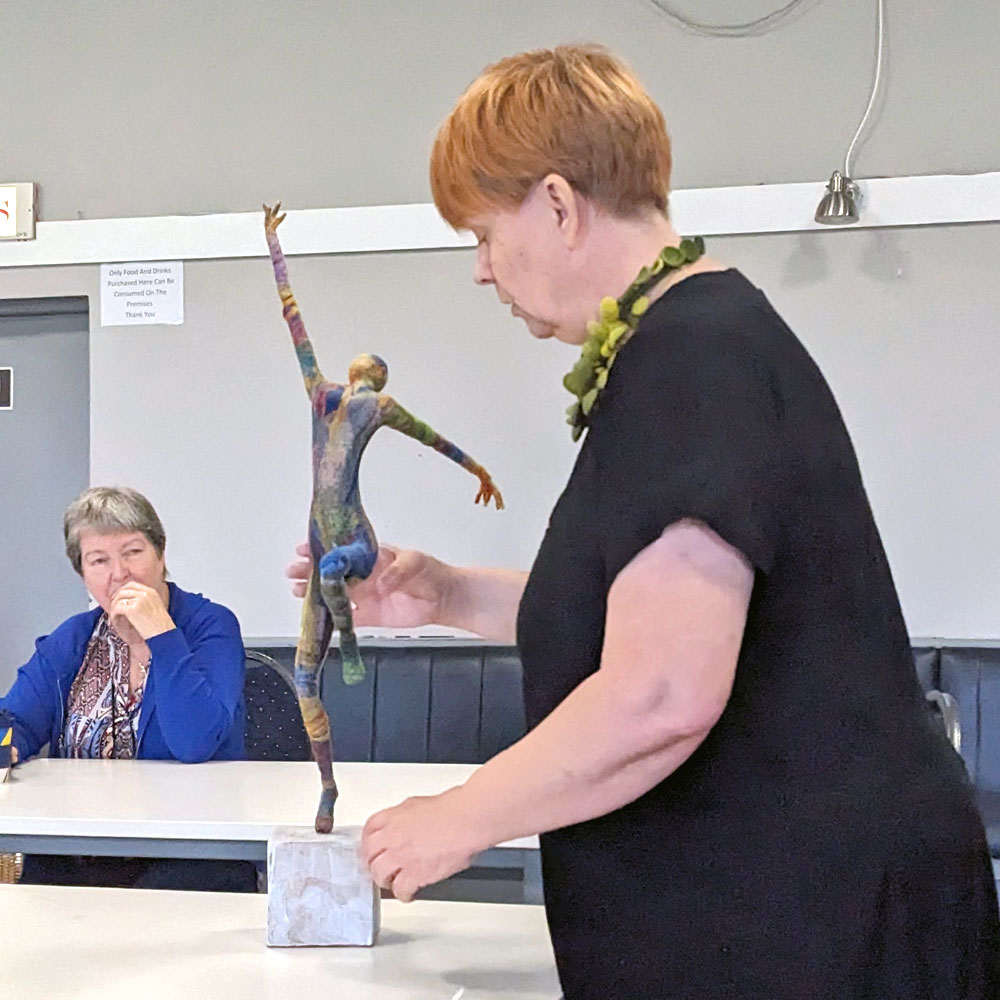
Annika learned about sculpting a woollen figure around a metal armature in UK-based Molly Williams‘ class. Annika shared how the metal goes through the base, which she made from ceramics.
The Felting and Fiber Studio

The Felting and FIber Studio is an international collective of felt and fibre artists with an active blog (which frequently includes needle felting). They also have a selection of online classes.

In ‘Nuno Felting with Paper Fabric Lamination’, Annika learned how to use an acrylic medium to ‘print’ onto fabric. She was especially interested in the textures the acrylic medium created.

Gladys Paulus

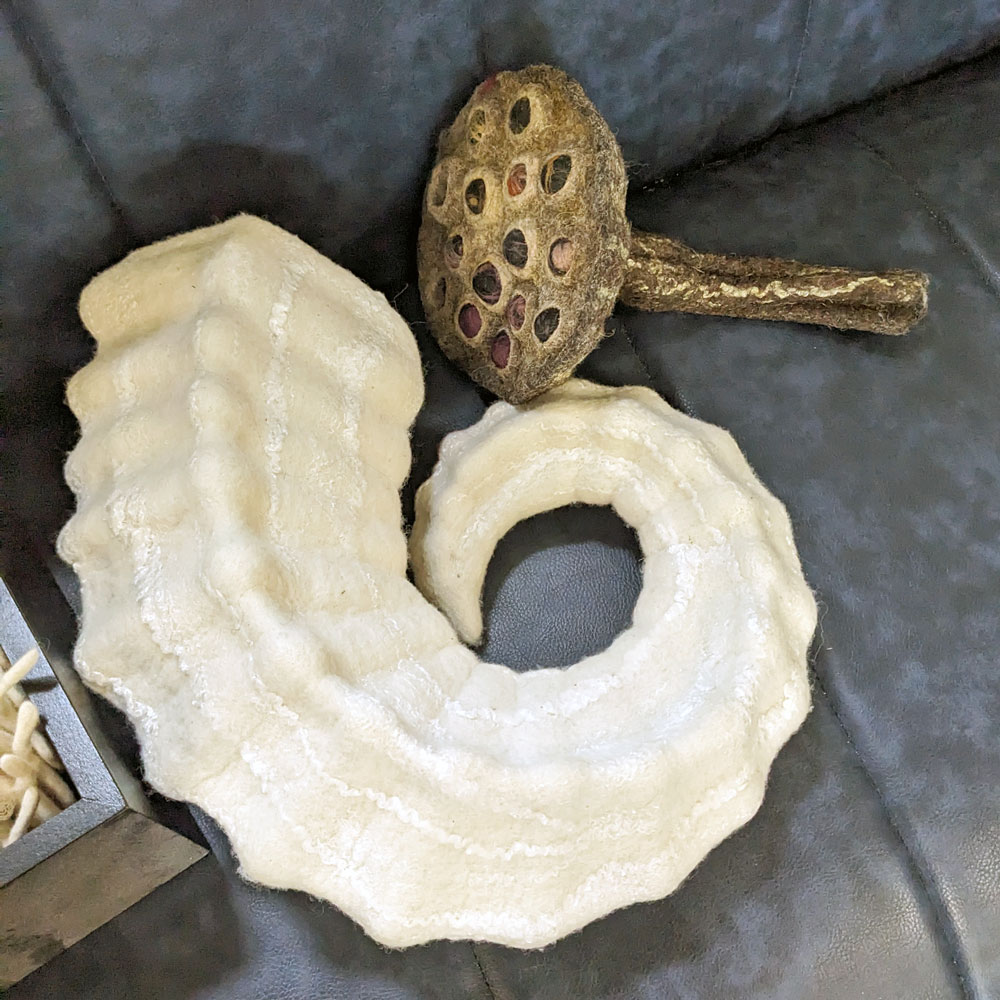
Dutch-Indonesian and based in the UK, Gladys Paulus only teaches in person a few times a year, and these classes fill up quickly. Annika is on the waiting list for a class that is next year. In the meantime, she took two classes with Gladys. Her first class was ‘The Lotus’, and the second was ‘Horns’ – where students made a straight and a curved one.

Annika highly recommends Gladys, “Well, she teaches you good felting. Where you can see the difference when you haven’t quite felted it enough, and when you felted it enough, that it takes shapes.”
Other Takeaways

The Links!

Some of the above teachers sell their finished products, supplies, and online workshops via their websites. Other tutors may need to be contacted directly for further information. Some of the teachers who teach online have recorded classes that are available year-round, while others have ones with specific availability. Several of the tutors teach additional classes which are not included below. Visit the links to be inspired and learn!

Links are grouped and in the approximate order of when mentioned during Annika’s presentation.

Classes that Annika took in person as part of Felting Camp

Felting Camp – https://cornitfelt.com/cornit-filztreff-2023-live-eng/

Anikó Boros – BaribonHu – https://baribon.hu/ 

Bea Németh – https://www.facebook.com/beanemez

Gabriella Kovács – https://kovacs-gabriella.hu/about/

Márti Csille – https://www.instagram.com/marticsille/ 

Nadia Szabó – https://www.etsy.com/shop/lunavifelt/ 

Classes that Annika took online

Pam de Groot – http://pamdegroot.com/

Fiona Duthie – https://www.fionaduthie.com/

Mandy Nash – https://mandynash.co.uk/workshops/upcoming-workshops/

  • Felt Fish – a YouTube recording. Email her via her website.

Eva Camacho – https://evacamacho.com/

Kristy Kun – https://kristykun.com/

Molly Williams – https://mollywilliams.co.uk/

The Felting and Fiber Studio – https://feltingandfiberstudio.com/

Gladys Paulus – https://www.gladyspaulus.com/

Both of Gladys’ online classes can be found on one page on her website – https://www.gladyspaulus.com/online-workshops

  • Inspired by Nature – The Lotus
  • Inspired by Nature – Horns

Suggestions?

If you have experienced other online felting-related courses that you have enjoyed, let us know. We will collect this information for a future post. – feltmakersIE@gmail.com
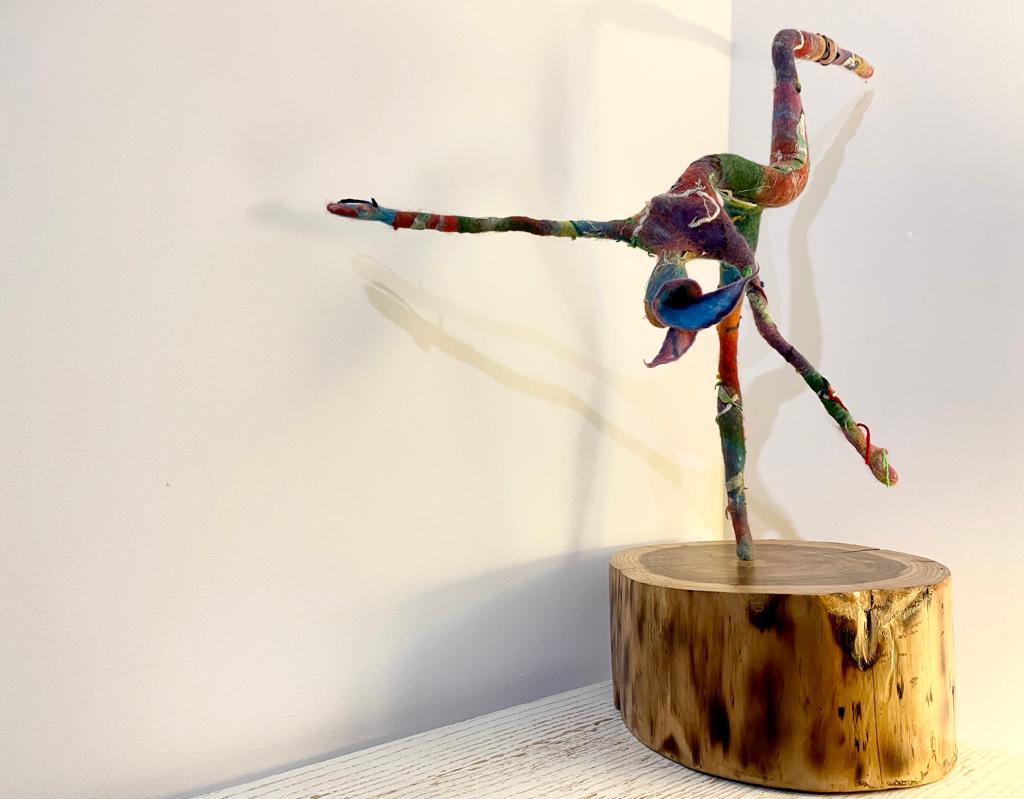
‘Contemporary Dancer’ – Felt workshop attended by Doris Reinisch, winner of Feltmakers Ireland’s bursary 2021 – report by Doris Reinisch

First of all, I would like to thank the Feltmakers Ireland for the generous Prize of 200 Euros that I have won in a prize draw after renewing my membership for 2021.
The prize money was contributing towards a felting workshop of my choice throughout the year 2021.

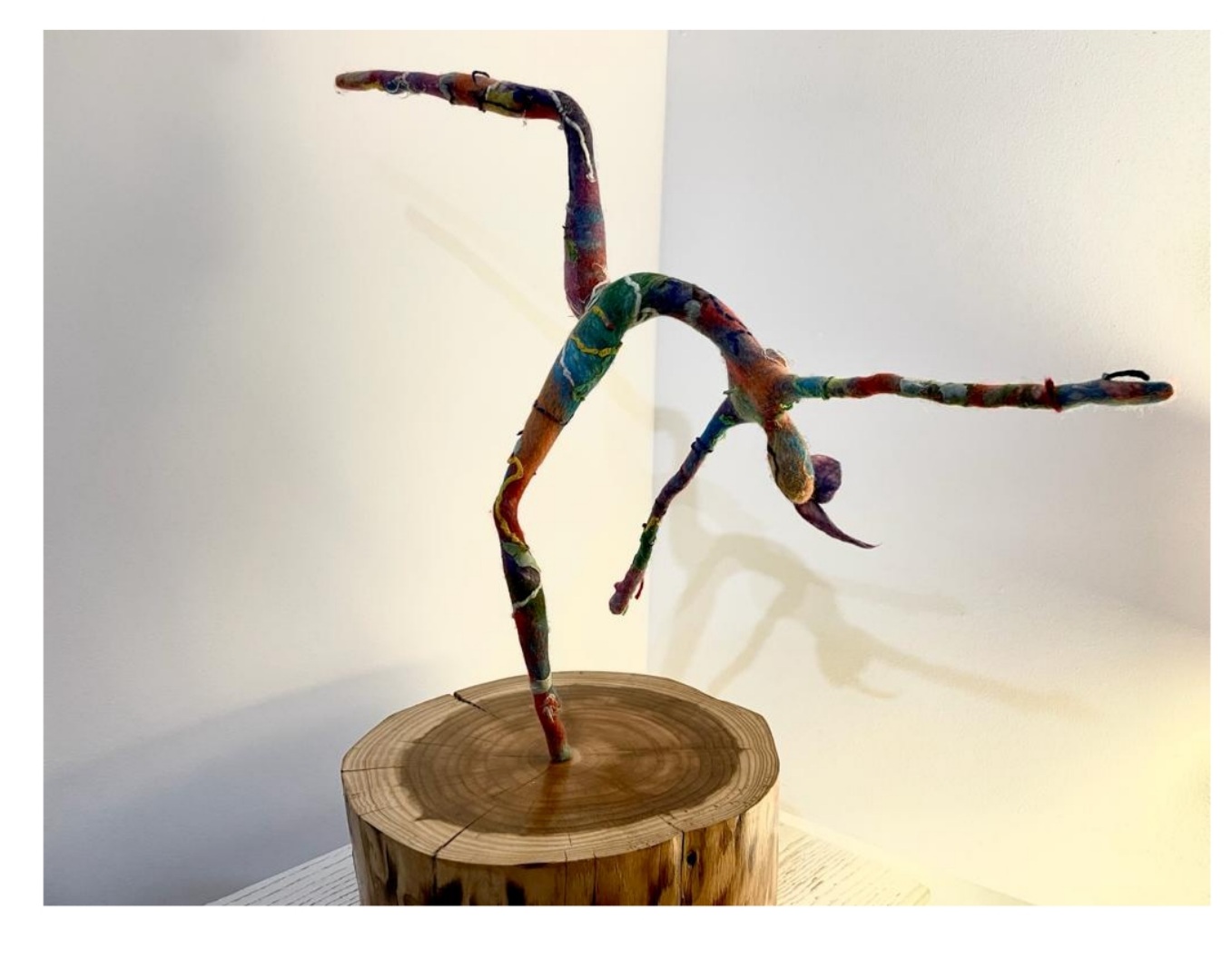
At the beginning of October 2021, I participated in a six week long virtual online 3D felting workshop called ‘Contemporary Dancer’ by Molly Williams.
The weekly course material was accessible via an online platform ‘ruzuku.com’.
Each weekly module was accessible with video instructions and the group of participants also had a Zoom meeting with Molly. We were able to discuss our projects, tips and tricks, and how to overcome difficulties throughout the different stages of completing the contemporary dancer sculpture.
The course was directed towards advanced skilled felters and the instructions were very clear and easy to follow.
It began with looking at the human form and drawing of the body in different shapes and movements. As we progressed towards selecting the movement and shape of the contemporary dancer, we were working with a sketch book to generate ideas.

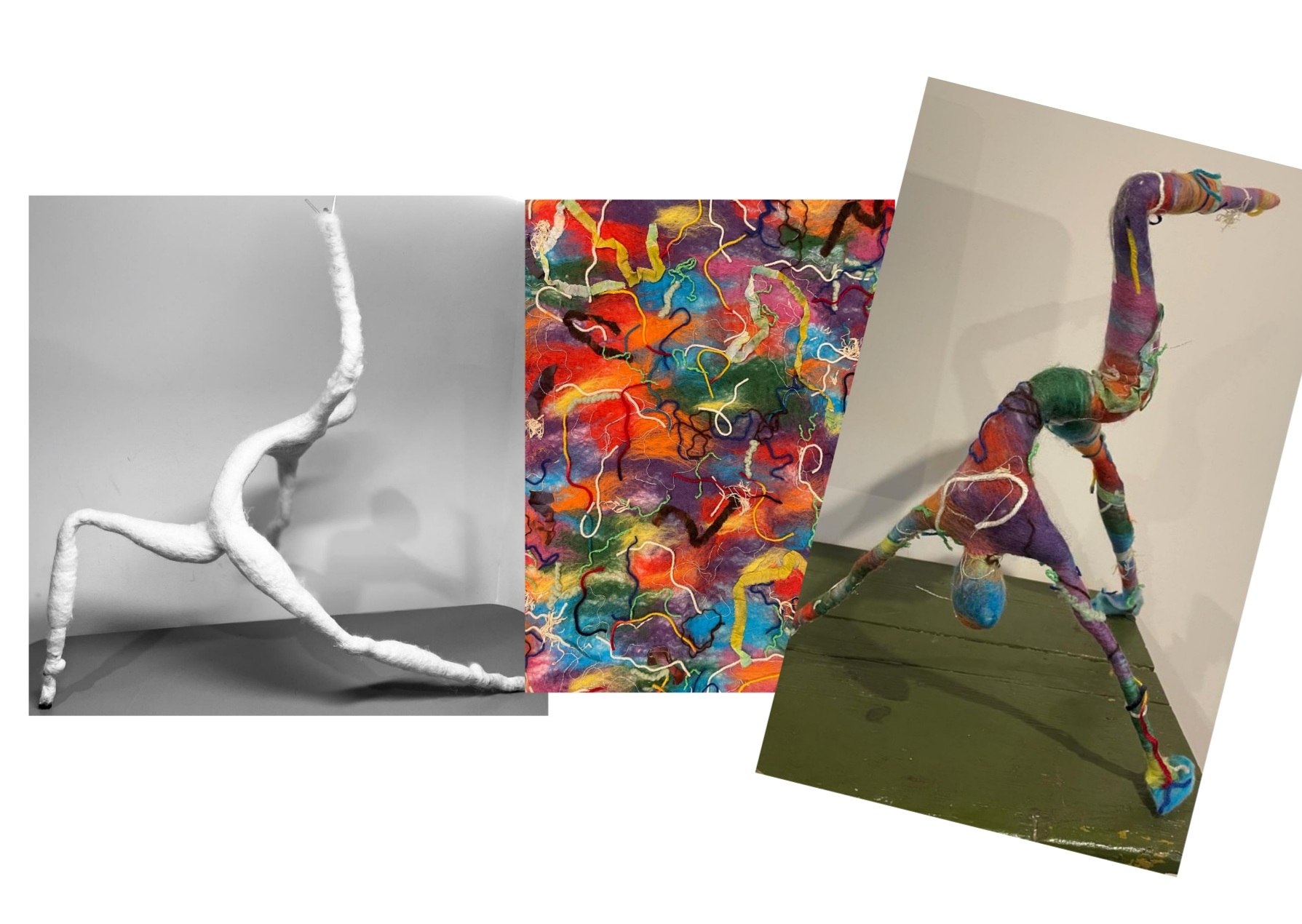
After deciding on the dancer position, we created the skeleton (50cm tall) of the body form with a strong wire. When the skeleton was ready, we added a tissue layer by covering the wire with a light wooly material strips as a felting starting point. We applied layers of felt wool to build up tissue and muscle of the body form.
This technique was an interesting experience for me, as we were applying the wool in a similar way as to working with clay. As soon as we were happy with the shape we created the skin by preparing a colourful and textured strong pre-felt. The skin was applied to the body where my sewing skills came in very useful.

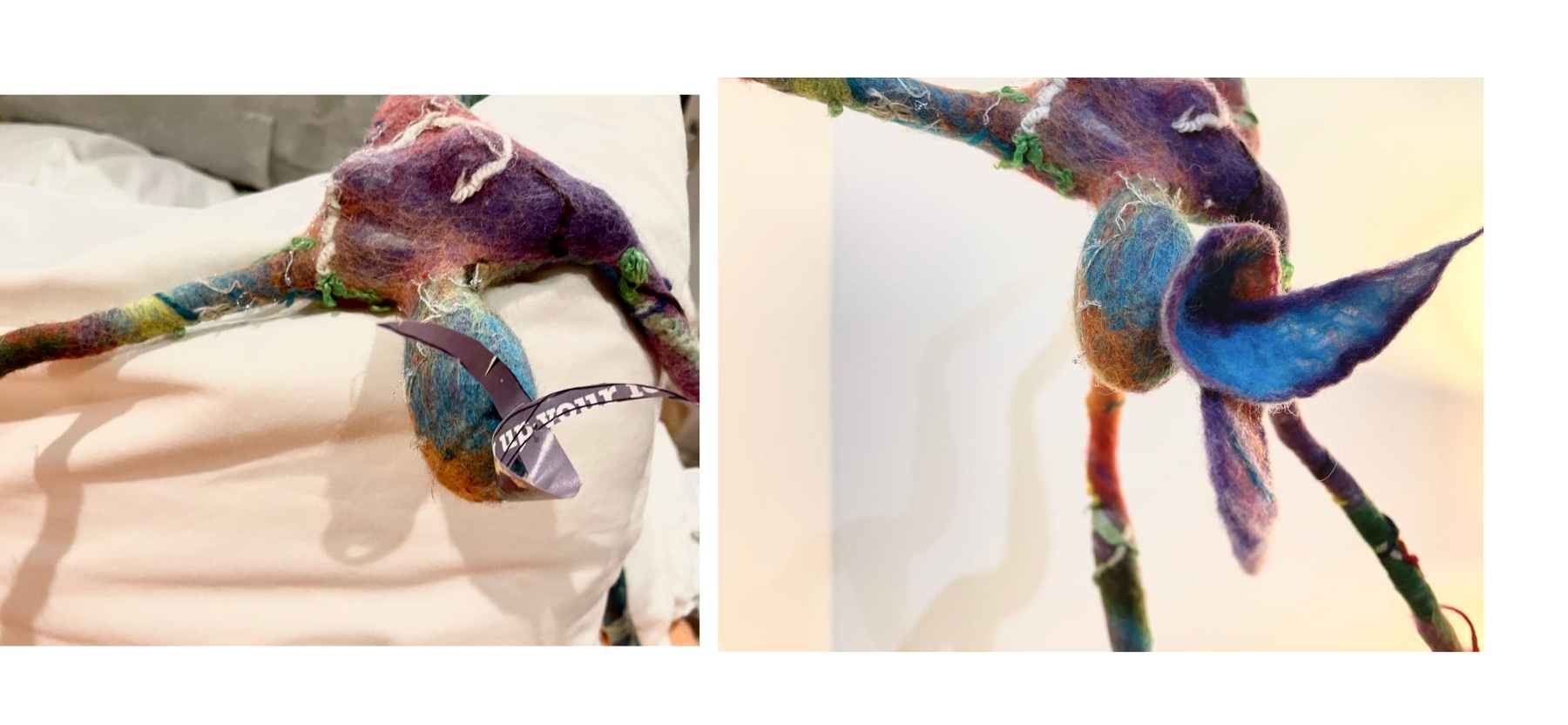
The next step was to wet-felt the whole dancer more intensely until the skin was felted on to the felted layer below. It was important to achieve a more solid final shape. After a few days, the felt sculpture was dry enough and the head was decorated with my prepared felted piece.
Finally, my contemporary dancer sculpture was ready to be attached to my wooden platform for display.

I had a lot of fun creating the sculpture, even if there were a good few challenges to master.
The workshop in general was well set up and the host was very helpful and supportive.
It was a great opportunity for learning and exchanging my felting experience with other experienced felters from abroad during the workshop in the zoom meetings and through online chatting on the course platform.
Participating in this workshop opened up a new perspective on using the felt technique for 3D sculpting, and it was new experience for me to participate at a felt workshop online.
Not just the outcome of my final sculpture, but also the journey involved was very enjoyable.
I thought I’d share a little insight about my participation at the contemporary dancer workshop with you.
If you have any questions I am here for you and you can contact me by email: dorisreinisch@yahoo.com.
Many thanks to you all.
Best regards,
Doris

Feltmakers Ireland would like to thank Doris for her lovely report and gratulate her for a brilliant result from the course.

We will raffle another bursary in the next month or two, so make sure to renew your membership in time to be in with a chance!

Breda Fay reports on Molly Williams on-line course

Breda Fay reports on her most recently undertaken on line course:

I have just completed an exciting online workshop with Molly Williams called “Contemporary Dancer”.  Six weekly lesson included presentations, videos and downloadable worksheets, illustrating simply and clearly the step-by-step procedure. Weekly online meetings with tutor were timetabled as much as possible to suit participants. Any queries or difficulties  could be discussed with Molly and it was great to see other participants’ progress. Over the six weeks we progressed from making a wire armature skeleton, to covering it with fabric before wet felting horizontal and vertical layers of fibre for the musculature. A large piece of embellished prefelt was then made for the colourful skin which was cut out and sewn onto the model before fulling and shrinkage. There was also an option to make the skin directly onto model. This was the one I chose. Finally  a head dress is designed for the figure before it is finally glued into a plinth. I cannot believe the I’ve got through the six weeks and have a very viable and I think stunning sculpture!

The armature

Molly Williams’ bio

Molly is a textile artist specialising in figurative felt sculpture. Contemporary and Modern dance inform the shapes and movement of the felt sculptures, and figurative shapes are a feature of her textile art. Molly lives in the UK and works from her studio in the garden. She teaches felt sculpture workshops internationally. Molly’s research interest is in Ottoman textiles, costume and ceramics and she has studied Ottoman costume and design to create replica kaftans and pattern design to be used to print textiles, wall art and other products. BA Hons Embroidered Textiles – Middlesex University Qualified Design and Technology Teacher – Christ Church Canterbury University Memberships: Prism Textile Arts Society of Designer Craftsmen International Felt makers Association Websites: www.mollywilliams.co.ukwww.fruitfulyear.co.uk

Reviews of Felt Courses by Annika Berglund

It seems this pandemic is just rolling on, with no real end in sight. It can be hard to stay positive at the moment, especially with the days getting darker and less scope for being outdoors. There are many ways to try to cope and to keep looking for the positive, and I wanted to share something that has been very helpful for me in all this. I live alone with my 12-year-old daughter and felt I needed something to help me stay connected and hopeful in the face of a long time with limited direct social interactions.

Feltmakers Ireland and sister organisations across the world have had to cancel workshops and meet-ups across the world due to the pandemic, the knitting and stitching show in Dublin being an example in point. All these cancellations have been hard on artists and teachers as a significant revenue stream has been cut off for them. A small spark of light in these troubled times is that the number of craft courses offered online has increased a lot, allowing access to knowledge and inspiration from a wide range of artists across the world.

I am a great fan of courses and workshops and love soaking up knowledge and inspiration from whatever artist or teacher available. I was in the fortunate position to have the time and the means to sign up to a number of online courses since the early summer, and I am certain that it has contributed in large part to keeping me relative sane through this very trying year. I know I would not have been able to attend such a range of courses if I had had to travel to each of them to participate. I also made a lot of new acquaintances and contacts by interacting digitally with the other students which has helped me stay positive and feel connected.

I have been asked to introduce you to some of these courses and give some ideas of courses coming up and where to find additional information if you are interested in taking a look for yourselves. These courses do cost money, but I personally have found them well worth the investment. With Christmas coming up you might be able to hint that they would be welcome in your Christmas stocking. If you still find that you cannot justify this expense, I hope to send out some more links to free online tutorials in the near future.

If you are interested in any courses similar to the ones I mention below, the best way to get enrolled is to go to the web page of the artist whose course you find interesting and sign up for their newsletter, or to follow them. They will then tell you when they have courses coming up and how to enrol. Fiona Duthie, (https://www.fionaduthie.com/workshops/online-felting-workshops/) for example is very popular. Her courses book up very fast and I already have a reminder in my calendar for the 4th of January when she will open registration for her 2021 courses. I just managed to get a spot on one of her courses in 2020 and hope to do more in 2021.

The first course I did took place during the summer, a course focussed on 3D felting, by the Australian artist Pam de Groot. (http://pamdegroot.com/online-courses.html )

This course helped improve the quality of my finished felt no end, and showed me many examples of how to take a 2D piece of felt and work it till it became a very different 3D object, based on shrinkage and different qualities obtained from different levels of thickness of the laid down wool. It also put me in contact with people from many different locations in the world who all shared an interest in felt and we created a small community that felt very encouraging and friendly.

 Surfac... logoSurface Form and Space Mid 2020 Pam de Groot

Here are some of the samples I made during this course

After this course there was no stopping me.

I signed up for a course with an American artist called Patti Barker: Demystifying felt resists. (https://www.pattibarker.com/workshops)

This was a shorter course, and Patti sent us all the materials needed for the course. All other courses send you a list of materials that you had to get yourselves. Patti shared some skills on how to get tighter, smoother felt by finishing by rolling the felt in on itself, without the bubble wrap. I made two little vessels, one as usual and one rolling it in on itself, and I must admit the second vessel looked better (the one on the left)

These are the samples I made in this course:

Another course I participated in was a two day live zoom course with UK artist Mandy Nash, making two different kinds of fish using a wool called bergschaus:

After that I joined a course led by Ruth Lane, called Nuno Felting with Paper Fabric Lamination. It added in mixed media techniques into felting which I found very interesting. I am still working on finishing samples from this course, but here is one that I am working on. I plan to add some beads and stitching. (https://permutationsinfiber.wordpress.com/about/ )

I have two other courses going on at the moment.

I managed to get a spot on one of Fiona Duthie’s 2020 courses: Felting over the Edge.

As the title implies it looks at how to do more with the edges of felt pieces. I still have 3 weeks to go to create a finished piece, but these are some of the samples I have made so far:

Recently I also started another course by Pam de Groot:

Texture and Dimension October 2020

The first part of the course teaches how to make a splash bowl. Easier said than done. These are my two first attempts:

In the 4 upcoming weeks we will be learning how to make spiral shell shapes.

I also have two more courses coming up end of this year, starting the new year, by two exciting artists:

Eva Camacho-Sanchez

Official Beyond Felting: Wool + Paper + Silk

https://evacamacho.com/online-classes

And a figurative 3D course by Molly Williams called Contemporary Dancer

https://mollywilliams.co.uk/felt-sculpture-workshops/

These courses do require a reasonable internet connection. Also, you will have to invest in materials for nearly all of them. Some of them are very specific in type of wool needed. Not all students in all the classes I have participated in have had the specified wool. Sometimes that worked fine, sometimes it made it harder to get the expected results. As I wanted to take so many different courses I had some problems with needing lots of different wools in a selection of colours. It would both be very costly and take up too much room in my house. This became obvious after the first course and I decided to only get white wool of the specified type and figure out how to dye it myself.  Some trial and error ensued, but I think I am getting the hang of it. That may be the subject of more blog entries in the new year.

Feel free to contact Feltmakers Ireland – Annika Berglund-if you have any questions about this blog entry or if there are subjects you would like us to look at or information you want to share.

Stay making! Stay in Touch and thanks for reading

Annika.