No payment will be necessary until our Secretary, Fiona, confirms your place. Then you’ll be asked for bank transfer or cheque.
If you have any questions, please let us know.
Disclaimer for Feltmakers Ireland Blog
Feltmakers Ireland aims to share information about awards, education, events, exhibitions, and opportunities that you will find interesting. Our sharing is neither paid for by nor an endorsement of these individuals or organisations.
Contact Us: If you have any concerns about content, please email us at feltmakersie@gmail.com.
Questions: For questions about content, please follow the link to the organisation involved in hosting the event.
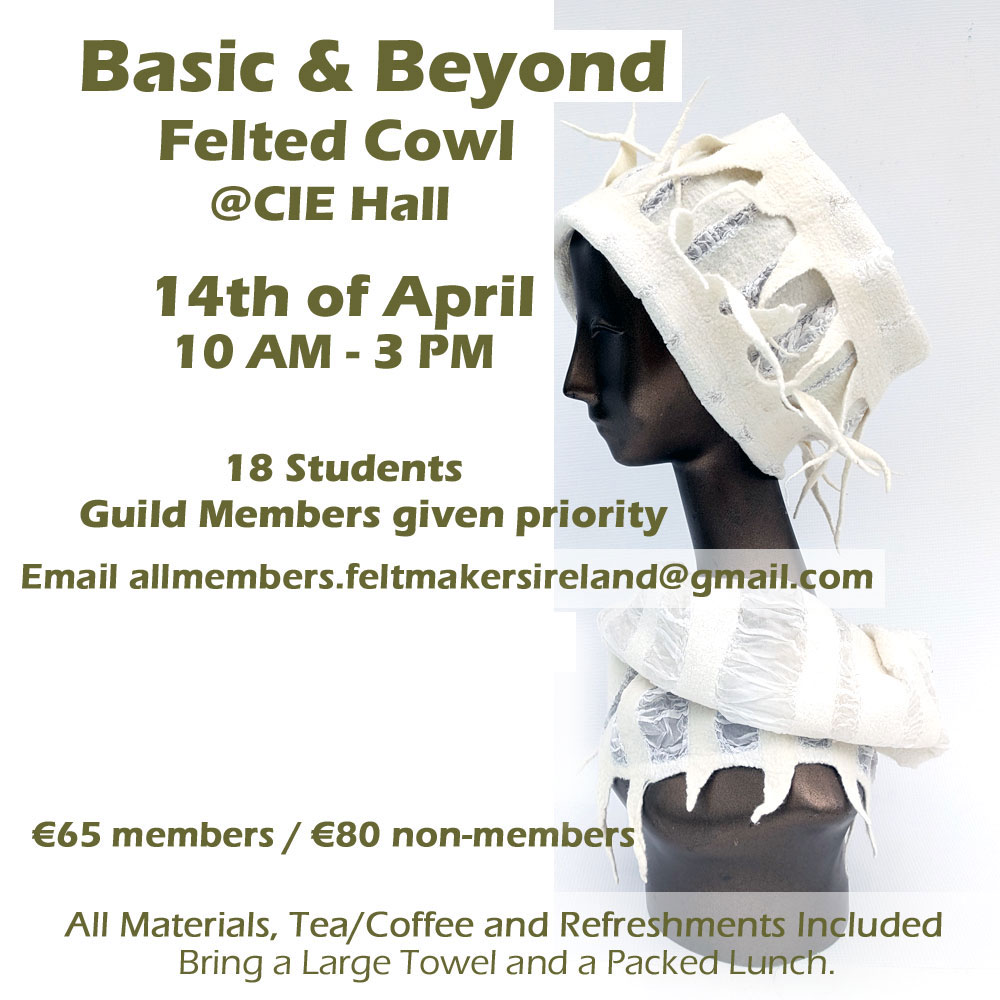
Students will learn two ways to make 3-D forms: one with a resist and one with differential shrinkage.
During the workshop, students will learn the basics about choosing and using colours for specific effects and how laying out the wool in certain patterns and thicknesses affects the shape of one’s vessel. In addition, students will learn how the direction of rolling and how long a piece is fulled affects the final shape of a bowl. Students will explore using various fibres and materials in the surface design of their pieces. The instructor will bring samples of different kinds of wool to touch so students can learn what type works better for larger or smaller pieces and the difference in surface texture and rigidity.
Feltmakers Ireland aims to share information about awards, education, events, exhibitions, and opportunities that you will find interesting. Our sharing is neither paid for by nor an endorsement of these individuals or organisations.
Contact Us: If you have any concerns about content, please email us at feltmakersie@gmail.com.
Questions: For questions about content, please follow the link to the organisation involved in hosting the event.
Feltmakers Ireland aims to share information about awards, education, events, exhibitions, and opportunities that you will find interesting. Our sharing is neither paid for by nor an endorsement of these individuals or organisations.
Contact Us: If you have any concerns about content, please email us at feltmakersie@gmail.com.
Questions: For questions about content, please follow the link to the organisation involved in hosting the event.
No payment will be necessary until our Secretary, Fiona, confirms your place. Then you’ll be asked for bank transfer or cheque. These details will be given later.
If you have any questions, please let us know.
Disclaimer for Feltmakers Ireland Blog
Feltmakers Ireland aims to share information about awards, education, events, exhibitions, and opportunities that you will find interesting. Our sharing is neither paid for by nor an endorsement of these individuals or organisations.
Contact Us: If you have any concerns about content, please email us at feltmakersie@gmail.com.
Questions: For questions about content, please follow the link to the organisation involved in hosting the event.
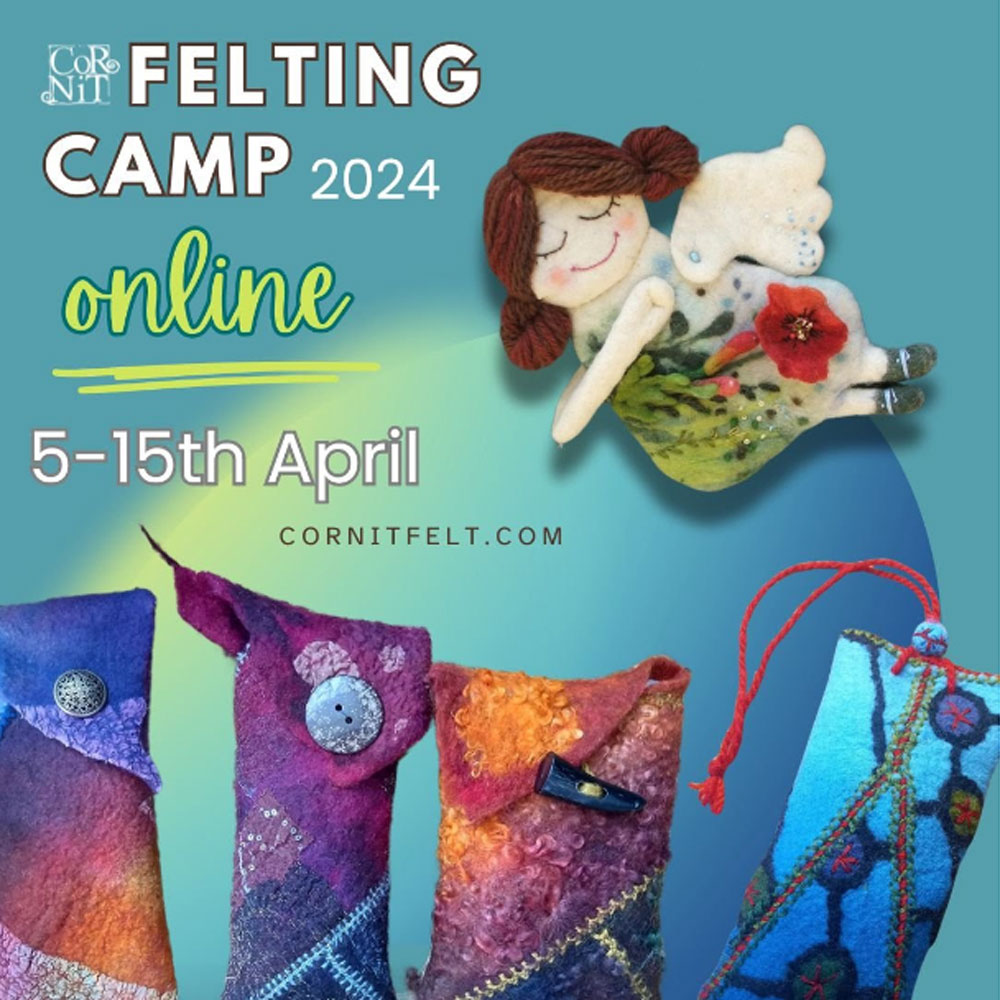
The CorNit Felting Camp is a multi-day, online felting event coming up this April. Join in online, interact with the instructors, and ask questions live during the session. The classes are also recorded, so you can work later at your own pace.
For each course, students receive a detailed pdf photo tutorial.
Feltmakers Ireland aims to share information about awards, education, events, exhibitions, and opportunities that you will find interesting. Our sharing is neither paid for by nor an endorsement of these individuals or organisations.
Contact Us: If you have any concerns about content, please email us at feltmakersie@gmail.com.
Questions: For questions about content, please follow the link to the organisation involved in hosting the event.
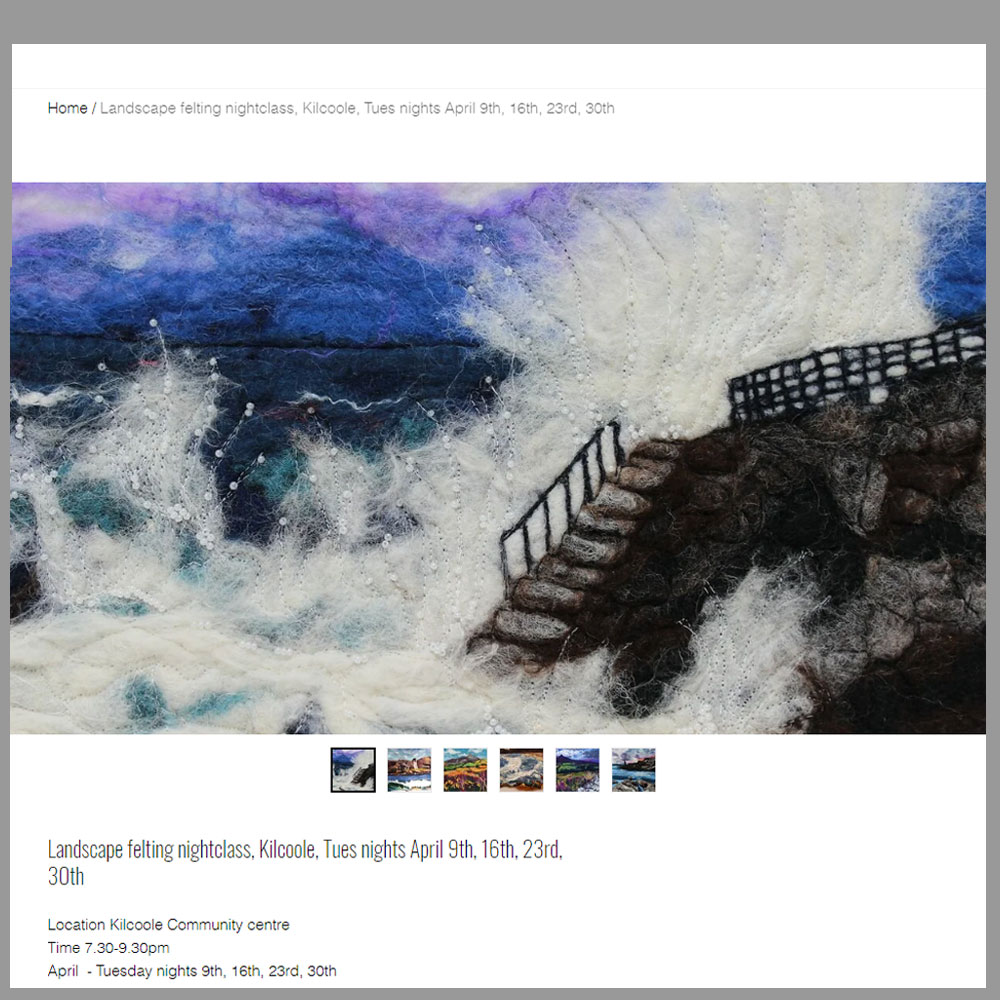
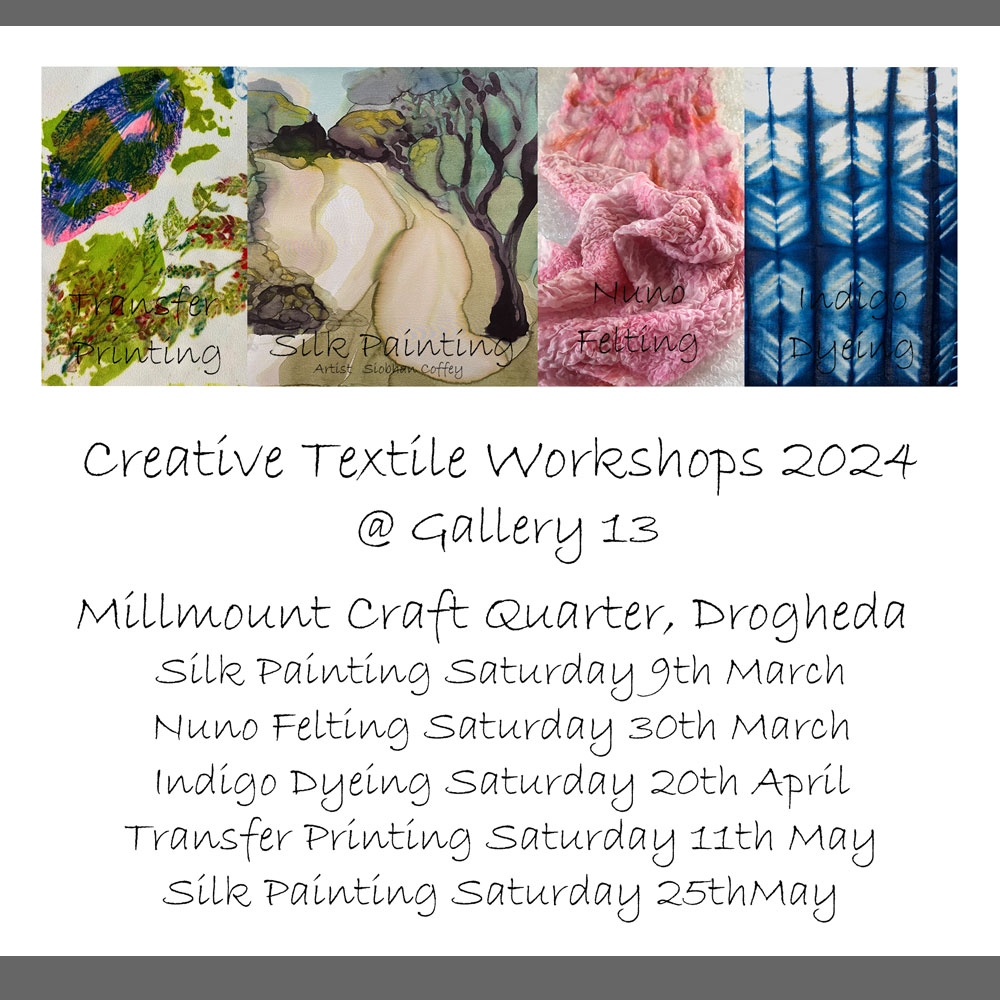
Feltmakers Ireland member Mel Bradley, a professional artist and teacher, will teach a series of five textile workshops this spring: silk painting, Nuno felting, indigo dyeing, and transfer printing. You can take one or multiple classes.
Classes are small and tailored to suit those attending.
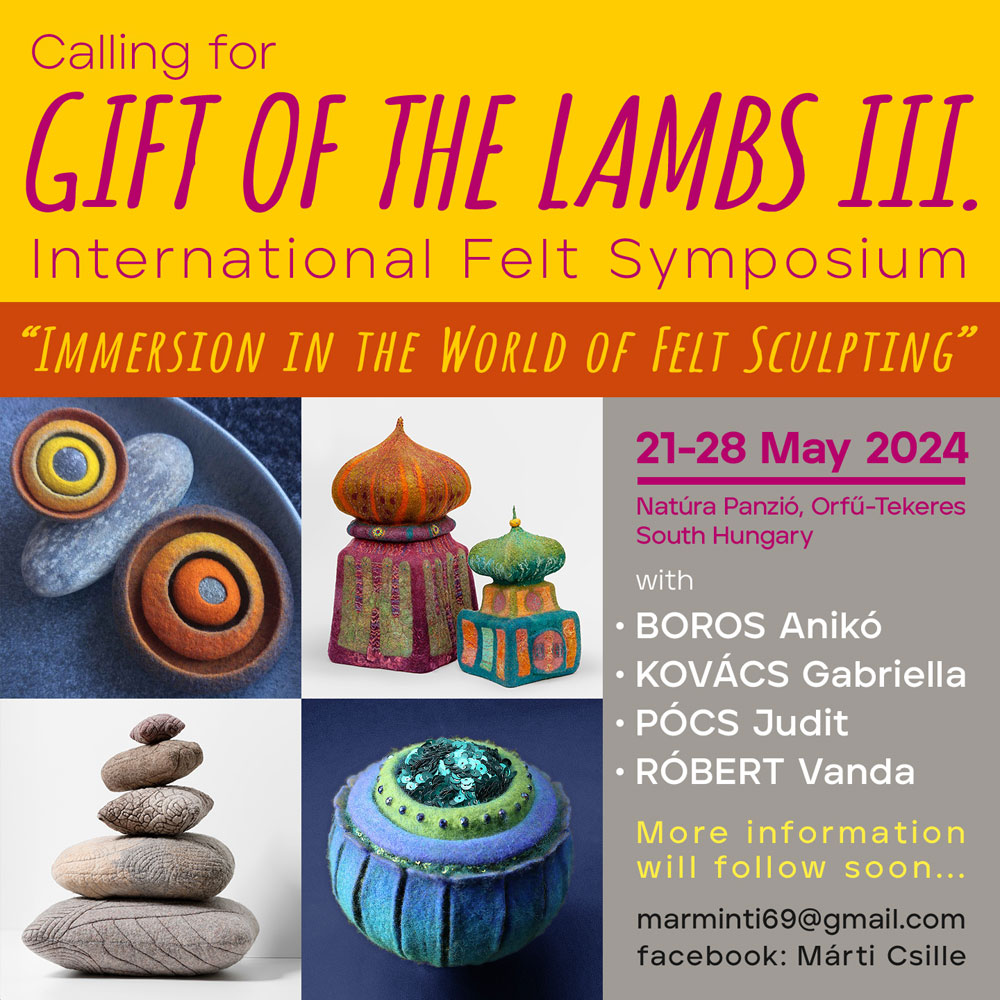
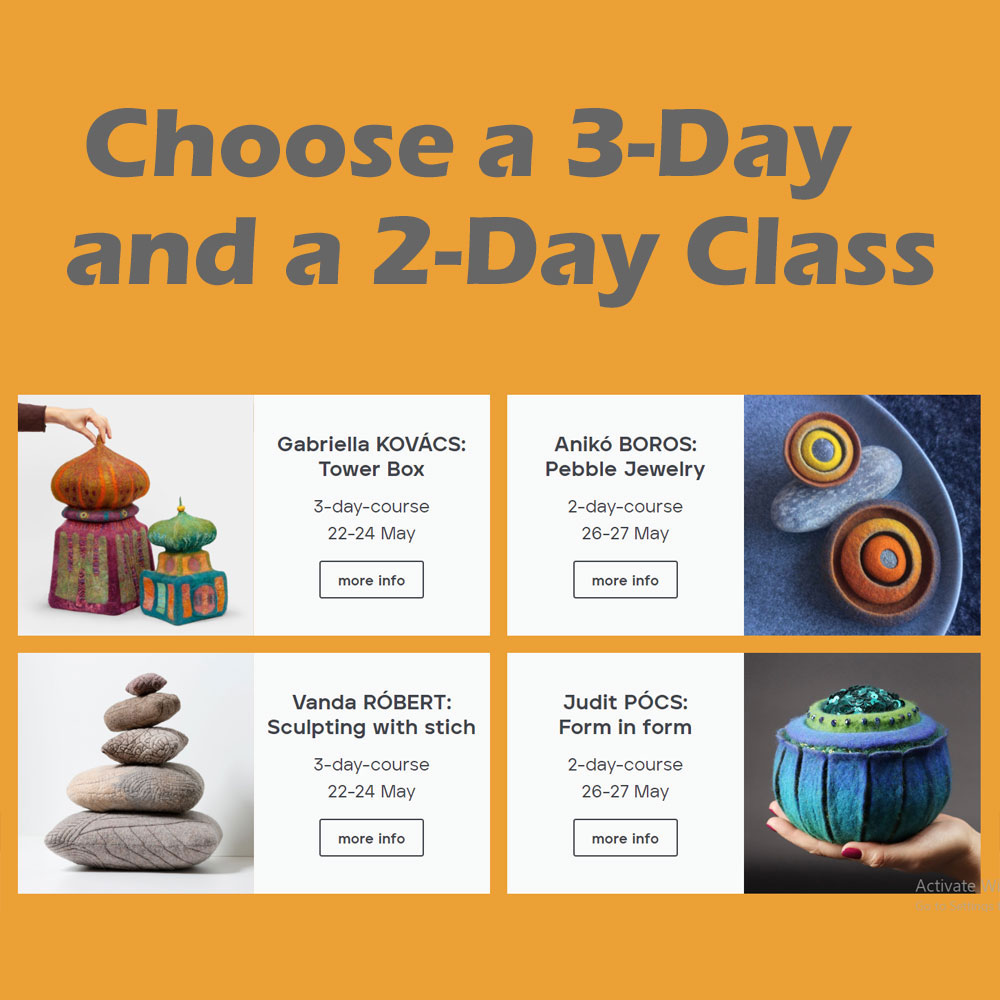
The theme of this Gift of Lambs international feltmaking symposium is ‘Immersion in the World of Felt Sculpting’. Students choose a three-day and two-day course from the four instructors. In addition, there will be a variety of cultural activities to explore.
Feltmakers Ireland aims to share information about awards, education, events, exhibitions, and opportunities that you will find interesting. Our sharing is neither paid for by nor an endorsement of these individuals or organisations.
Contact Us: If you have any concerns about content, please email us at feltmakersie@gmail.com.
Questions: For questions about content, please follow the link to the organisation involved in hosting the event.
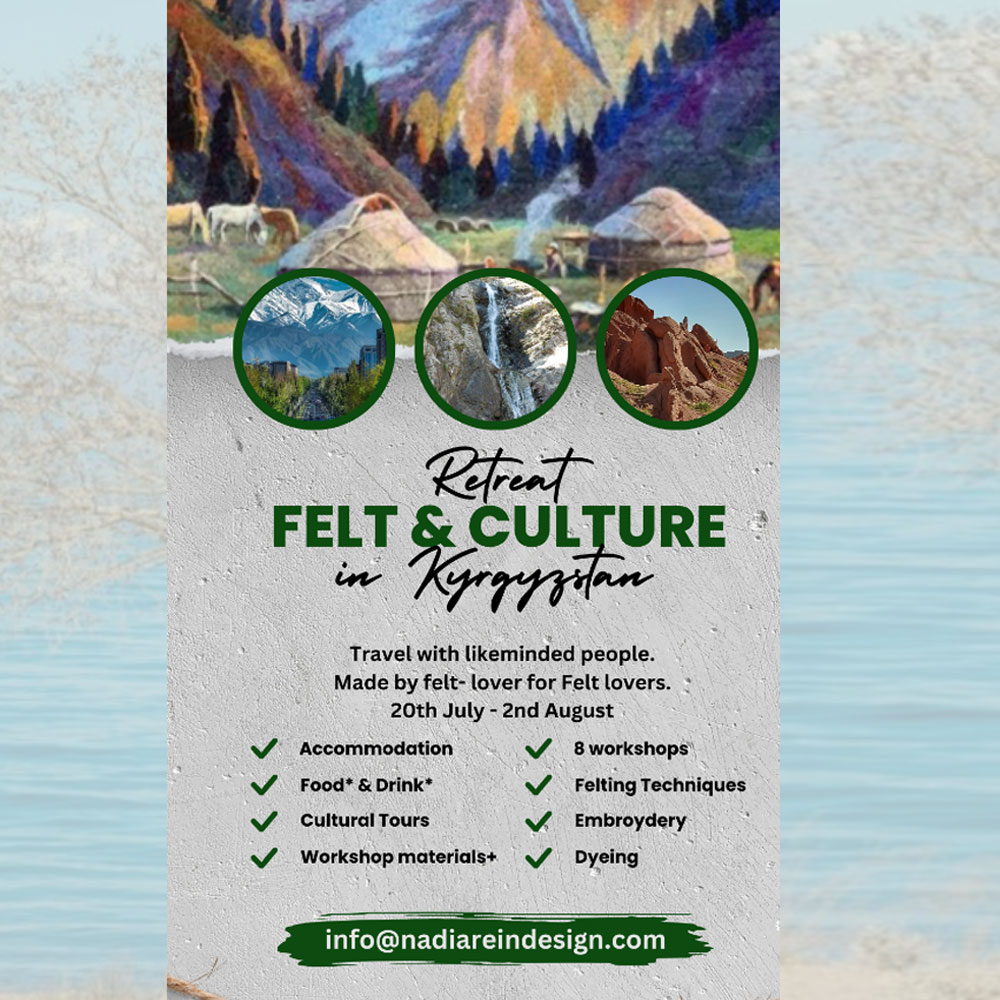
Nadia Rein (who happens to be the IFA’s Publicity Officer) has organised a Felting Retreat to Kyrgyzstan this summer. The retreat includes eight workshops over 13 days with local Kyrgyz artists in Bishkek. There will also be an overnight trip to Lake Issyk-Kul with a stay in a traditional yurt. The retreat’s dates coincide with a large textile festival called Oimo in Bishkek, which features textile artists from all over Western Asia.
Participants on the trip will experience traditional felting techniques (including Shyrdak and Kyrgyz embroidery) and contemporary felting techniques. Additionally, attendees will experience the region’s culture.
Feltmakers Ireland aims to share information about awards, education, events, exhibitions, and opportunities that you will find interesting. Our sharing is neither paid for by nor an endorsement of these individuals or organisations.
Contact Us: If you have any concerns about content, please email us at feltmakersie@gmail.com.
Questions: For questions about content, please follow the link to the organisation involved in hosting the event.
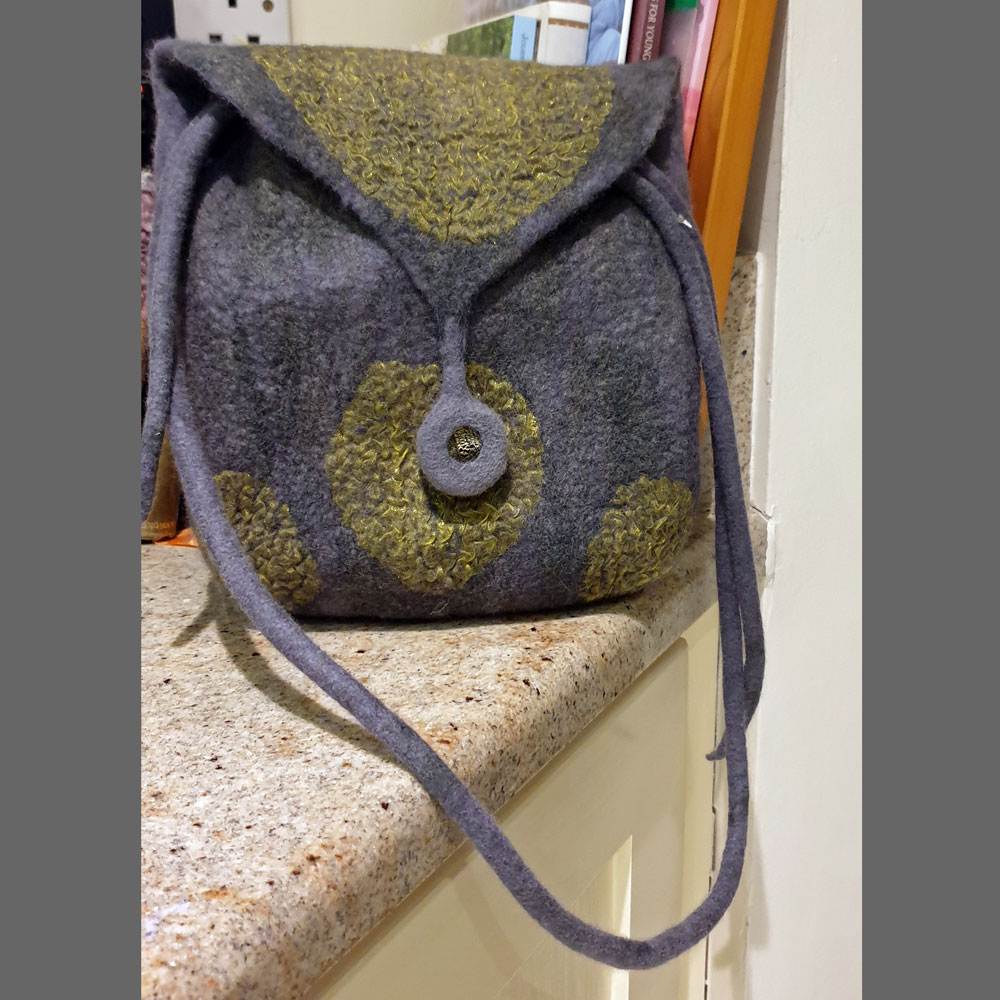
Breda Fay’s felted purse was created in Aniko Boro’s/Baribon.HU’s online course.
Guest Post by Feltmakers Ireland member Breda Fay.
Pebble Shoulder Bag Workshop with Anikó (Baribon.hu)
Anikó’s Boros course, creating a felted Pebble Shoulder Bag, was designed to take place on the Zoom platform over two days (five hours daily). The learning goals were to make a small bag with a flap top and a closure with an enclosed pebble, to use organza as a surface decoration, and to dye the bag to create a gradient or ombre effect. The “enclosed pebble” is almost a trademark of the Baribon experience, and in this case, it would provide the weight for the bag flap to stay closed.
A list of materials and a clear and well-illustrated step-by-step PDF of the instructions were sent to all students in advance so that they had time to be prepared. There were also suggestions on colour choice, pebble size and weight, and dyeing. While my preferred option was to work alongside Anikó during the live Zoom meeting, there was also an option to receive the recorded material and work at your own time and pace.
Having previously done three courses with Aniko, I was well aware of the teaching competencies of the Baribon Community – Anikó, who is the tutor; Andrea, her wonderful humorous hostess/translator; and her hubby and son, who are in charge of the IT.
Day 1
After a short introduction, including technical info and a general description of the process, we started cutting out the template for the bag and the pebble closure from resist material, cutting the pattern for the embellishment, and then the fabric itself. Some participants could not find the needed embellishment fabric and instead substituted other fabric. Then, we proceeded to lay out the complex arrangement of fibres and wet them down, following along with Anikó’s instructions.
DAY 2
On the second day, we finished felting the bag and proceeded to fulling and shrinking. Anikó is a believer in being thorough and having no shortcuts. So hot water and vigorous rubbing were very much reserved only for the final shrinking process. Our bag was complete, rinsed and stuffed to dry before our coffee break.
The dyeing process began after the break. I used Leiko Uchiyama’s hand-dyed merino and silk for my outer layer of fibre and consequently did not want to dye. However, the dyeing provided a better gradient of colours in a much easier way than laying out fibres.
We then created the cord. I was delighted to achieve a wrinkle-free, strong cord – but it took well over an hour of felting, fulling and shrinking.
We all showed our work at the end and had a chat about what we had learned. There was also a raffle among the participants for a Baribon piece of jewellery.
What I Liked and Learned:
There was a second template of a small phone bag for those who wanted to work on a smaller scale.
Opportunity to ask questions and present your work during the course.
Loved the sheen and exciting surface of the embellishment fabric; it is similar to wood bark. But it did take work to get it incorporated – I can’t wait to try it again!
Opportunity to ask questions throughout the presentation and chat with participants during the breaks.
An opportunity to join a Facebook page to see the work of all – and for any further queries.
Editor’s Note: We recommend signing up for the email newsletters of instructors that you are interested in. That way, you are informed of upcoming courses.
Editor: Thank you, Breda, for your interesting article about your experiences with the Pebble Bag Workshop. If you are a member of Feltmakers Ireland and want to share your educational experiences with our readers, please email feltmakersie@gmail.com
On Sunday, the 11th of February, 22 students gathered around artist and Feltmakers Ireland guild member Annika Berglund to learn about Fine Feltmaking.
Annika demonstrates how to make clean edges on flat felt.
What is Fine Felt?
With this type of wet felting, the aim is to create dense, smooth felt. It is not a fast process; we didn’t toss or throw but took it slow. Annika said we might never seek this patience-requiring method again, but we would know and have the option to use it in our future felting.
Throughout the workshop, the students used only two colours: black and white. This simple limitation allowed us to experience how colours combine through the feltmaking process.
Everyone gathered around to watch the steps of the process.
Morning
In the morning, we worked two-dimensionally. We learned how to carefully lay out Merino wool roving to a specific size and then gently transform the fluff into felt. Annika explained the hows and whys of why we might want to shrink our samples more or less.
Annika shows how to adjust the corners.
Afternoon
In the afternoon session, the students concentrated on creating a three-dimensional vessel – a sphere. We used a flat resist to create this hollow form. Similar to our morning education, this felting process needed a delicate touch.
Annika shares how to remove the resist.
Students concentrate on their work.
Feedback
Many of the students were fairly new to wet felting and appreciated learning the mysteries of the process. Several enthusiastically reported they would continue felting at home with Annika’s suggestions on how to create new samples with different shrinkage rates.
Students’ Work
Top row: Margaret Ryan, Loli Cox.
Second row: Valerie O’Ceallaigh, Sandra Reynolds.
Third row: Caitriona Nolan, Suzette French.
Fourth row: Samantha Fagan.
Fifth row: Ruth Dawson, Claire Wallace.
Sixth row: Ramona Farrelly.
Appreciation Time
Many thanks to the volunteers who assisted the students. Lorna Cady, Deirdre Crofts, Marian Fagan, Juliane Gorman, Fiona Leech, and Clodagh McDonagh.
Special thanks to Clodagh McDonagh and Adrienne Dempsey, who refreshed everyone’s water containers with the needed water temperatures – at times lukewarm and other times hot!
Clodagh with the kettles of boiling water.
Additional appreciation to Elizabeth Redding and Valerie Nowak Oceallaigh, who helped with the morning registration process and the selling of our book, ‘Exploring Irish Wool for Feltmaking’.
Elizabeth at the entry table.
As always, special thanks to Fiona Leech for taking care of the tea, coffee, and sweet treats!
Lastly, a huge thanks to Annika Berglund for taking on this workshop for the Guild. She has a marvellous way of getting the students’ attention and also making us laugh!
Editor’s note: as more students email photos, we will add them to this blog post.








 Feltmakers Ireland